
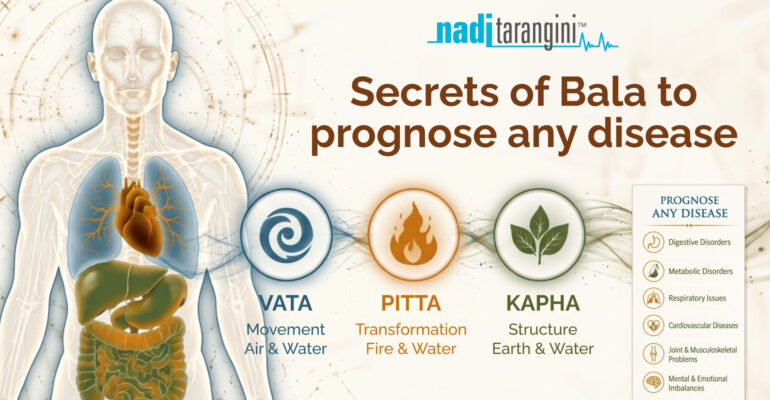
Secrets of Bala to prognose any disease
Secrets of Bala to prognose any disease
 Vaidya Tejaswini Bhale
Bala is one of the key indicators of health in Ayurveda. It is influenced by inherent constitution, seasonal changes, age, lifestyle, and nutrition. Understanding Bala according to Prakriti, vaya, desh and ritu helps individuals adopt personalized health practices that support vitality, immunity, and long-term well-being.
Rugna Bala and Vyadhi Bala in Ayurveda
Ayurveda emphasizes the assessment of both the patient and the disease before planning treatment. Two important concepts used in clinical evaluation are Rugna Bala (strength of the patient) and Vyadhi Bala (strength or severity of the disease). Understanding these factors helps the physician determine the prognosis, select appropriate therapies, and estimate the patient’s ability to recover.
Rugna Bala (Strength of the Patient)
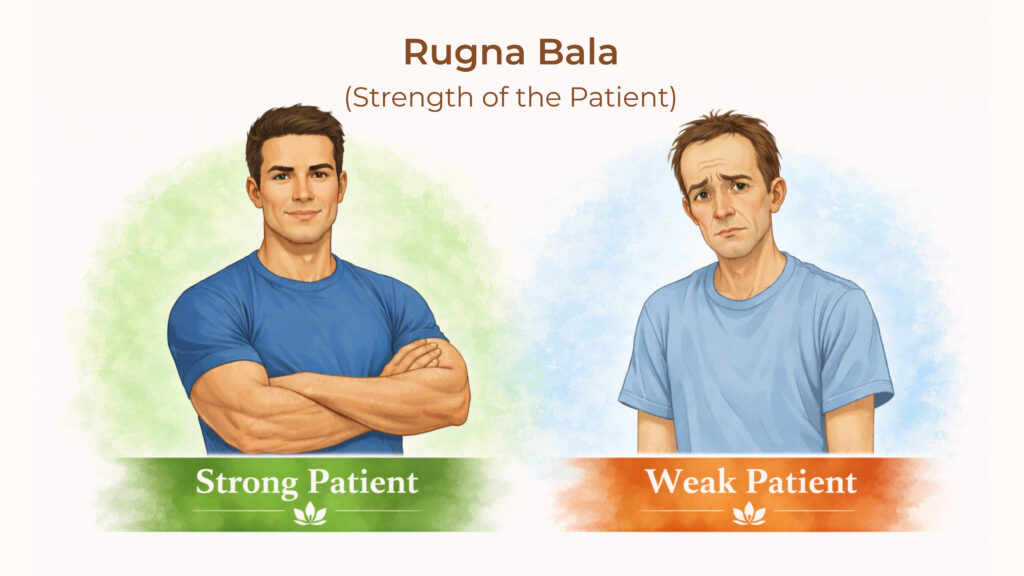
Rugna Bala refers to the overall strength, vitality, and resistance of the patient. It reflects the body’s capacity to withstand disease and respond to treatment.
Assessment of Rugna Bala includes evaluation of:
- Prakriti (Constitution) – Kapha individuals generally possess greater physical strength than Pitta and Vata individuals.
- Sara (Tissue Excellence) – Quality of saptadhatu/ body tissues such as muscle, blood, and bone.
- Samhanana (Body Build) – Compactness and structural integrity of the body.
- Satmya (Adaptability) – Ability to tolerate different foods, environments, and therapies.
- Satva (Mental Strength) – Emotional stability, courage, and psychological resilience.
- Vyayama Shakti (Exercise Capacity) – Endurance and physical performance.
- Age and Seasonal Factors – Strength varies according to age and season.
A patient with good Rugna Bala can tolerate stronger treatments, recover faster, and generally has a better prognosis.
Vyadhi Bala (Strength of the Disease)
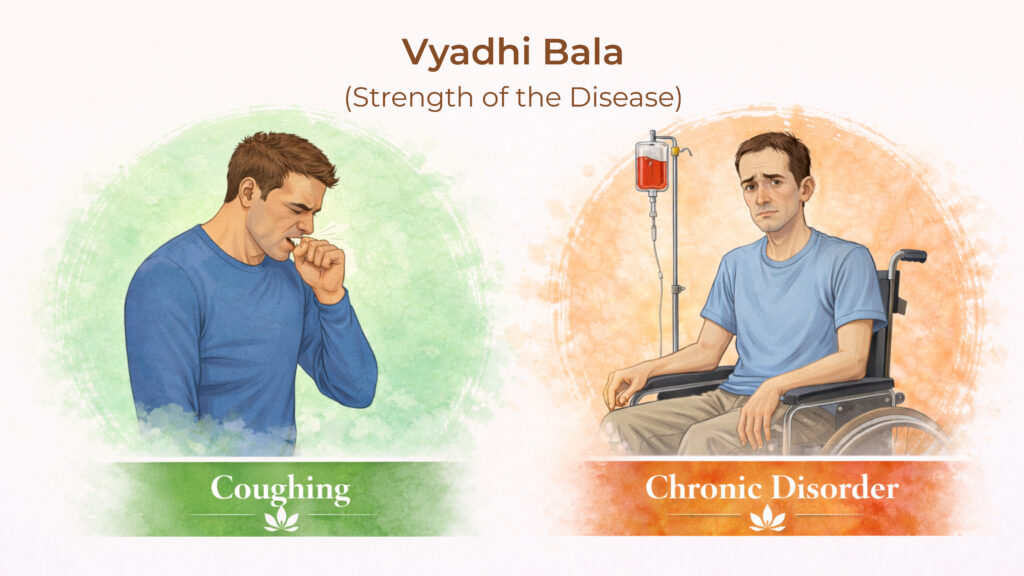
Vyadhi Bala refers to the intensity, severity, and progression of the disease. It indicates how strongly the disease affects the body and how difficult it may be to treat.
Assessment of Vyadhi Bala includes:
- Severity of Dosha Imbalance
- Number of Doshas Involved
- Depth of Tissue Involvement (Dhatu Dushti)
- Duration of Disease
- Presence of Complications
- Rate of Progression
- Manifestation of Symptoms
Diseases involving multiple doshas, deeper tissues, chronic duration, or severe complications are considered to have higher Vyadhi Bala.
Clinical Importance
The relationship between Rugna Bala and Vyadhi Bala guides treatment decisions:
- Strong Patient + Mild Disease: Excellent prognosis and quicker recovery.
- Strong Patient + Severe Disease: Intensive treatment may be given with reasonable chances of success.
- Weak Patient + Mild Disease: Gentle and supportive treatment is preferred.
- Weak Patient + Severe Disease: Prognosis may be guarded, requiring careful management and strengthening therapies.
Rugna Bala and Vyadhi Bala are fundamental diagnostic concepts in Ayurveda. While Rugna Bala measures the patient’s capacity to resist and recover, Vyadhi Bala assesses the strength of the disease itself. Accurate evaluation of both allows the physician to provide individualized treatment, improve outcomes, and ensure safe clinical practice.
Nadi paraiksha
This is an important distinction. In the context of Nadi Pariksha, the term Bala refers to the force, strength, or amplitude of the pulse, not directly to the broader concept of patient strength (Rugna Bala) used in Dashavidha Pariksha.
Ancient texts that discuss Nadi Pariksha—particularly Sharangadhara Samhita, Bhavaprakasha, and Yogaratnakara—describe Bala as one of the characteristics of pulse assessment, along with Gati (movement), Vega (rate), Tala (rhythm), and other qualities.
Bala in Nadi Pariksha
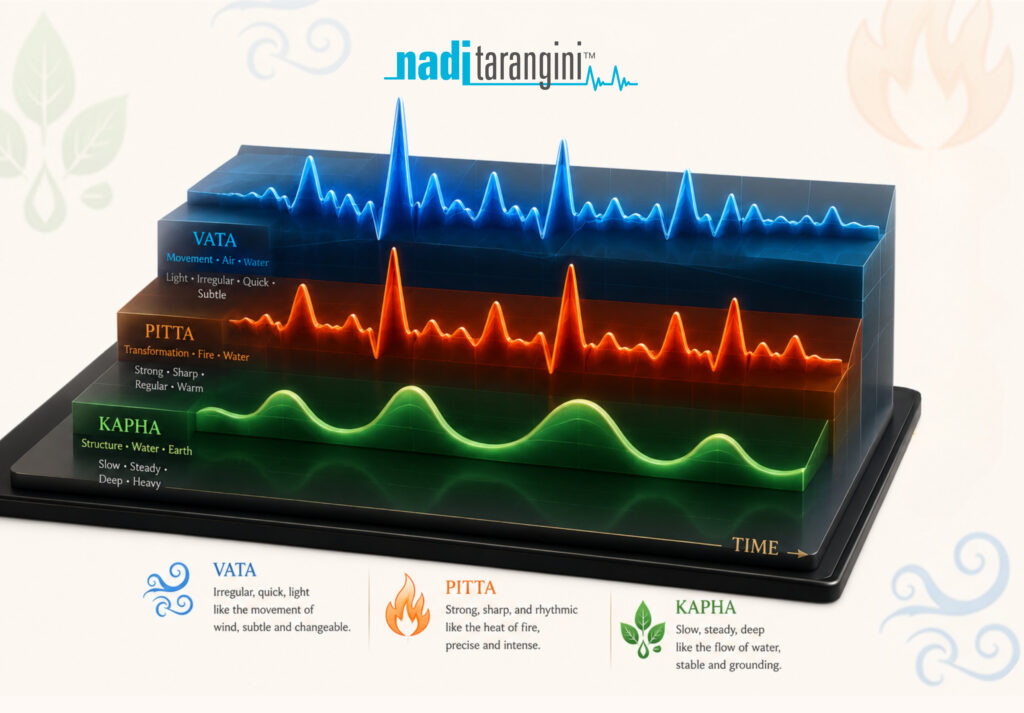
When examining the pulse, the physician evaluates:
- Pulse force
- Fullness of the pulse
- Resistance felt under the fingers
- Depth and stability
- Ease of palpation
A pulse may be:
Pravara Bala (Strong Pulse)
- Full and forceful
- Easily palpable
- Stable and well sustained
- Indicates good Ojas, strong Dhatus, and better vitality
Madhyama Bala (Moderate Pulse)
- Moderate force and volume
- Regular and stable
- Suggests average strength and physiological balance
Avara Bala (Weak Pulse)
- Thin, feeble, or thread-like
- Difficult to perceive
- Easily collapses under finger pressure
- May indicate depleted Dhatus, low Ojas, chronic disease, exhaustion, or advanced age
Bala According to Dosha Dominance
Some traditional Nadi texts associate pulse strength with Doshic predominance:
| Dosha | Pulse Bala |
|---|---|
| Vata | Low (Alpa Bala) |
| Pitta | Strong (Prabala Bala) |
| Kapha | Moderate to Strong (Madhyama Bala) |
Vata pulse is often described as lighter and weaker, Pitta pulse as stronger and more forceful, and Kapha pulse as steady, broad, and moderately forceful.
Relation to Rugna Bala
Traditional Vaidyas did not assess patient strength solely from pulse force. A strong pulse was considered one indicator of vitality, but it had to be correlated with:
- Prakriti
- Sara
- Samhanana
- Satva
- Age (Vaya)
- Agni
- Disease severity (Vyadhi Bala)
Only after integrating all these findings would the physician determine the patient’s true Rugna Bala. (Jaims)
Classical Clinical Interpretation
Many traditional Nadi practitioners summarize the concept as:
“Nadi Bala reflects the strength of the life force expressed through the pulse, whereas Rugna Bala reflects the overall strength of the individual.”
Thus, in ancient Nadi Pariksha, Bala is primarily a pulse characteristic (force and amplitude), while in Ayurvedic diagnosis as a whole, Bala is a much broader measure encompassing physical, mental, and immunological strength.
Clinical Importance of Bala
Assessment of Bala helps determine:
- Disease prognosis
- Treatment suitability
- Panchakarma eligibility
- Recovery potential
- Need for Rasayana therapy
In traditional Ayurvedic texts, along with Nadi Pariksha, bala is always combined with:
- Darshana (observation)
- Sparshana (touch examination)
- Prashna (questioning)
And interpreted through:
- Agni (digestive fire) – As per Agni, suggest design gut health plan- deepan – enhance agni
- Ama (toxins)- To digest aam, detox plan which is pachan chikitsa
- Dhatu status (tissues)- To nourish dhatus
- Ojas (vitality)- Rejuvenation to bring bala at extreme level
Therapeutic importance of Bala
For diagnosing rugna bala and vyadhi bala, the physician or therapist or wellness practitioner should design a personalised treatment and therapy protocol which will help to increase rugna abla and reduce disease to gain health and stability.
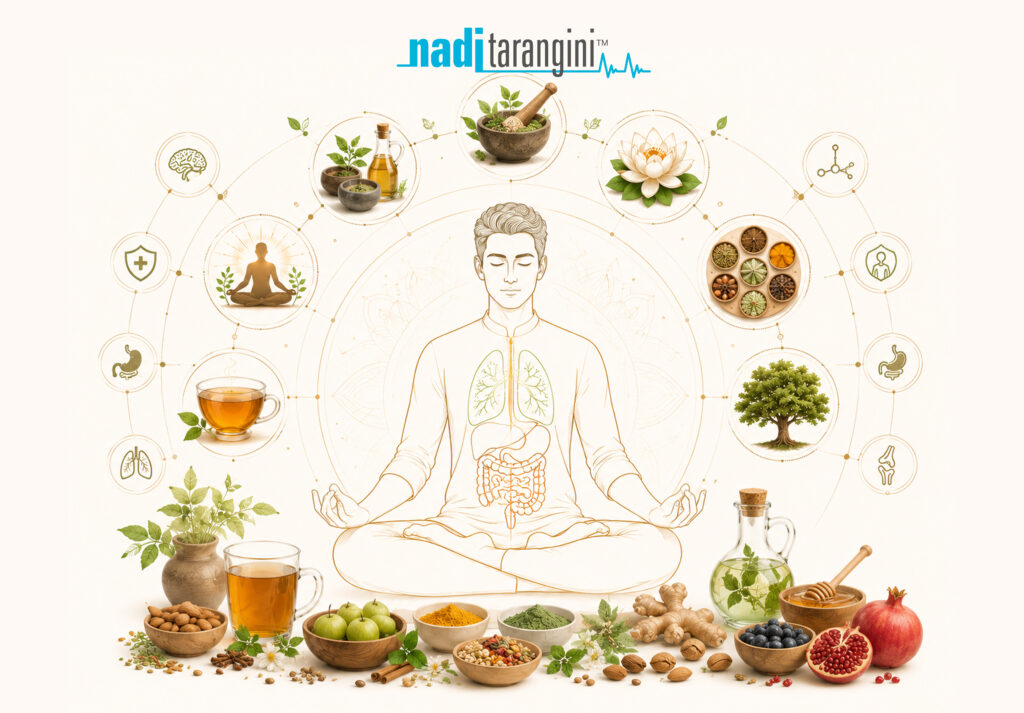
Lets think and follow a regime given below to enhance bala which will offer health, wellness and longevity.
- Balanced nutrition
- Strong digestive fire (Agni)
- Regular exercise
- Adequate sleep
- Stress management
- Seasonal regimens (Rutucharya)
- Daily regimen (Dinacharya)
- Rasayana therapies
- Meditation and mental well-being
That’s why Bala has importance in the prognosis of any disease. In the next article I will discuss how Bala is to learn and calculate through nadi pariksha. Also, Nadi Tarangini is useful to give reliable and more than 80% accurate analysis.