
Understanding Concept of Bala
 Vaidya Tejaswini Bhale
Bala (Strength) in Ayurveda
Bala is a fundamental concept in Ayurveda that signifies physical strength, vitality, immunity, mental resilience, and the body’s ability to maintain health. The Sanskrit word Bala means “strength” or “power.” It reflects an individual’s capacity to resist disease, recover from illness, perform daily activities efficiently, and maintain overall well-being.
Types of Bala
Ayurveda classifies Bala into three categories:
1. Sahaja Bala (Innate Strength)
This is the natural strength a person is born with. It depends on one’s constitution (Prakriti), parental health, and genetic factors.
2. Kalaja Bala (Time-Dependent Strength)
This type of strength varies according to age, season (Rutu), and time. It naturally fluctuates throughout life and during different seasons.
3. Yuktikrita Bala (Acquired Strength)
This strength is developed through proper diet, exercise, lifestyle practices, good sleep, and rejuvenative therapies (Rasayana). Ayurveda medicines, panchakarma.
Bala According to Prakriti
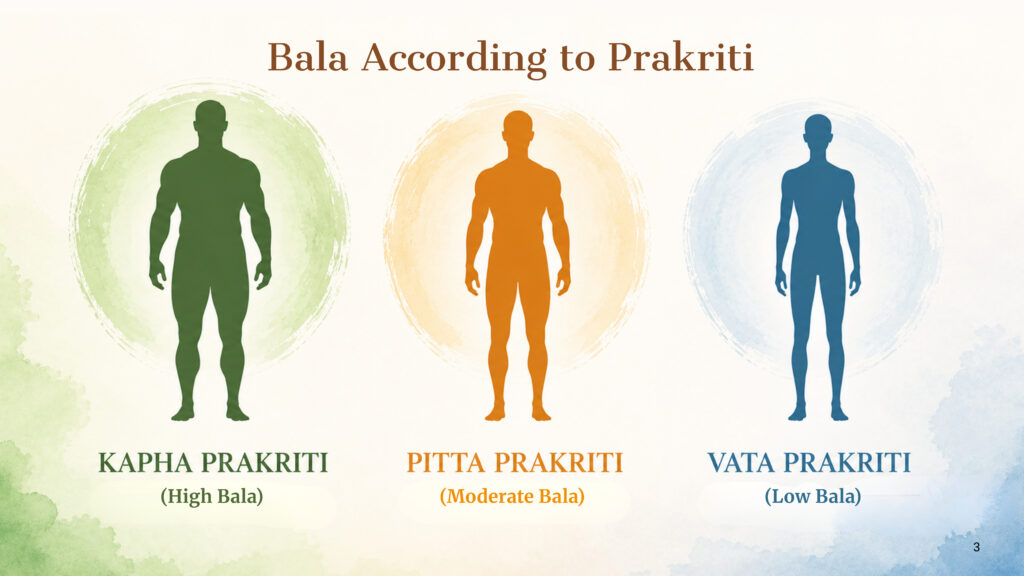
An individual’s constitutional type significantly influences their natural strength.
Kapha Prakriti
People with Kapha-dominant constitutions generally possess the highest physical strength and endurance. They have well-developed muscles, stable energy, strong immunity, and greater resistance to disease. Their Bala is usually considered superior among the three constitutions.
Pitta Prakriti
Pitta individuals possess moderate strength. They have good metabolism, determination, and work capacity. Although they perform tasks efficiently, their endurance may be lower than that of Kapha individuals.
Vata Prakriti
People with Vata-dominant constitutions generally have comparatively lower physical strength and stamina. Their energy levels may fluctuate, and they may be more susceptible to fatigue. However, they often demonstrate agility, creativity, and mental adaptability.
Bala According to Age (Vaya) and Desha in Ayurveda
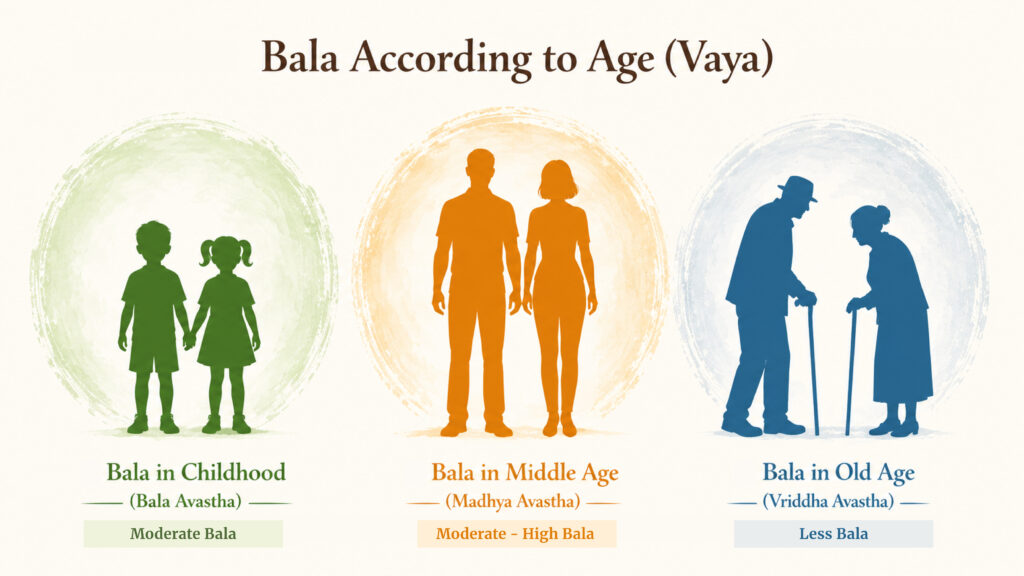
Bala According to Age (Vaya)
Ayurveda recognizes that strength naturally varies throughout different stages of life. This variation is one of the factors considered while assessing an individual’s overall Bala.
Bala in Childhood (Bala Avastha)
Childhood is the Kapha-dominant stage of life. Although children possess good growth potential and tissue-building capacity, their bodily systems are still developing. Therefore, their Bala is considered incomplete or immature. They are generally more susceptible to infections and digestive disturbances and require special care, nourishment, and protection.
Bala in Middle Age (Madhya Avastha)
Middle age is considered the period of maximum strength. During this stage, all body tissues are fully developed, digestion is strong, and physical as well as mental capabilities are at their peak. Ayurveda regards this period as the time of optimum Bala, endurance, productivity, and resistance to disease.
Bala in Old Age (Vriddha Avastha)
Old age is dominated by Vata Dosha. With advancing years, tissue depletion (Dhatu Kshaya), reduced digestive power, and declining physiological functions lead to a gradual decrease in Bala. Strength, stamina, immunity, and recovery capacity become comparatively lower, making supportive and rejuvenative measures especially important.
Bala According to Desha (Habitat or Geographical Region)
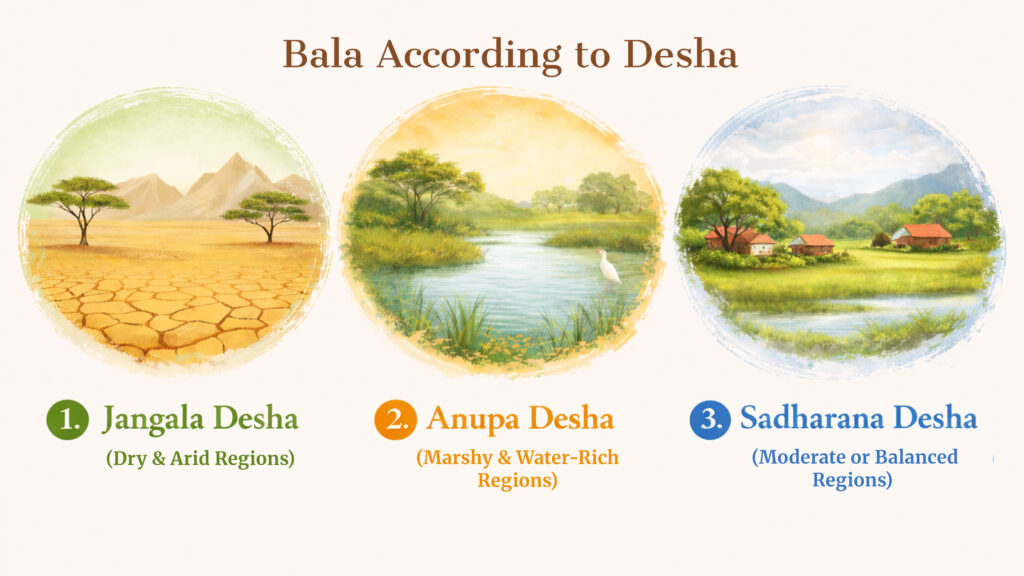
Ayurveda teaches that geographical location influences the strength and constitution of individuals.
Jangala Desha (Dry and Arid Regions)
These regions are characterized by dryness, less vegetation, and predominance of Vata and Pitta qualities.
People living in such areas often develop greater toughness, endurance, and adaptability due to exposure to harsher environmental conditions.
Their Bala is generally considered good, though dryness-related disorders may be more common.
Anupa Desha (Marshy and Water-Rich Regions)
These regions have abundant water, coastal area, dense vegetation, and Kapha predominance.
People living here often possess well-nourished bodies and good physical strength. However, Kapha-related conditions such as congestion, obesity, and sluggish metabolism may occur more frequently.
Sadharana Desha (Moderate or Balanced Regions)
These regions have balanced environmental characteristics without excessive dryness or moisture.
Such areas are considered ideal for maintaining equilibrium of the Doshas and promoting stable health and Bala.
Bala According to Seasons (Rutus)
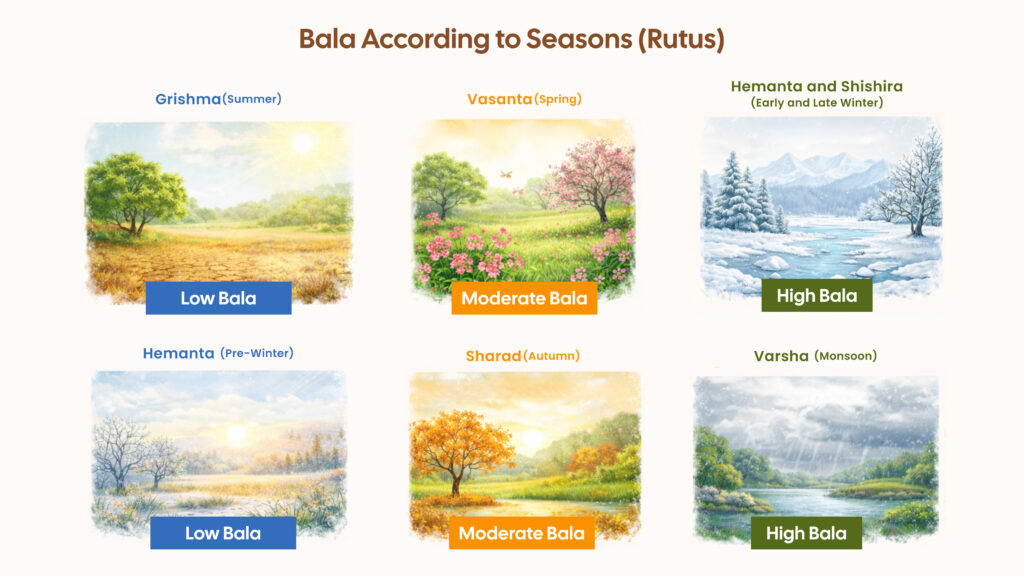
Ayurveda explains that strength changes naturally with seasonal variations.
Hemanta and Shishira (Early and Late Winter)
Bala is at its highest during winter. Digestive fire is strong, nourishment is better utilized, and the body develops greater strength and immunity.
Vasanta (Spring)
Strength begins to decrease as accumulated Kapha starts melting and circulating in the body.
Grishma (Summer)
Bala reaches its lowest level. Heat, dehydration, and reduced digestive capacity can weaken the body and reduce stamina.
Varsha (Monsoon)
Strength remains relatively low due to weakened digestion and increased Vata aggravation.
Sharad (Autumn)
Bala gradually improves as the body recovers from the effects of the rainy season.
Hemanta (Pre-Winter)
Strength increases again, preparing the body for the period of maximum Bala.
Importance of Bala
Bala is not merely muscular power; it encompasses immunity (Vyadhikshamatva), mental stability, enthusiasm, endurance, and the capacity to withstand stress and disease. A person with good Bala enjoys better health, longevity, productivity, and resilience.
Enhancing Bala
Ayurveda recommends maintaining and improving Bala through:
- Following Deenacharya and Rutucharya
- Prakriti based Balanced and nourishing diet
- Balanced Jatharagni Strong Gut health
- Regular exercise appropriate to one’s constitution/ Prakriti
- Follow sleep routine and rest
- Stress management and positive mental habits
- In today’s era stop excess use of mobile, screen time and social media
- Panchakarma and Rejuvenative therapies to gain and maintain health
In Ayurveda, to prognose any disease, two aspects of Bala are considered. One is Rugna bala means persons bala which we discussed above and other is Vyadhi/Rogi bala means strength od disease.
I will discuss about it in my next article. Alos, how to understand bala through Nadi pariksha and using nadi tarangini.