
Flexibility score analysis through eyes of Ayurveda and Modern science using Nadi Tarangini
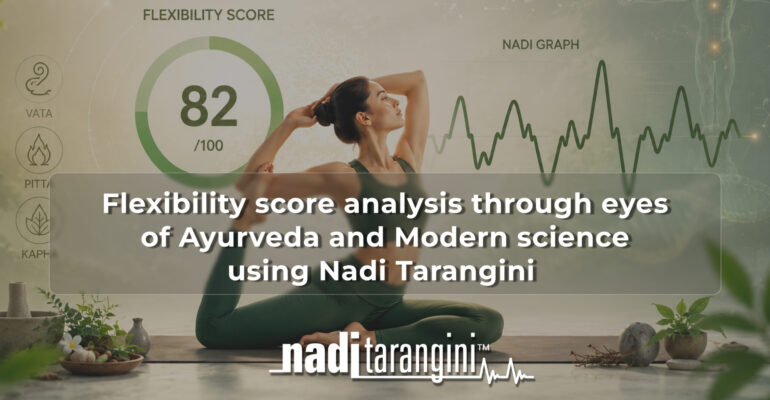
Flexibility score analysis through eyes of Ayurveda and Modern science using Nadi Tarangini
 Vaidya Tejaswini Bhale
Flexibility score: The Foundation of an Agility
Flexibility is the ability of the body’s muscles, tendons, ligaments, joints, and spine to move freely through their full range of motion without pain or restriction. It is an essential component of physical fitness and plays a vital role in maintaining mobility, balance, posture, and overall health throughout life.
Healthy muscles are supple and elastic, allowing smooth movement and reducing the risk of strains and injuries. Tendons, which connect muscles to bones, must maintain their strength and flexibility to efficiently transfer force during movement. Ligaments provide stability to joints by connecting bones to one another. While ligaments are not meant to be highly stretchable, they require optimal elasticity and integrity to support joint health without becoming overly tight or lax.
Understanding Flexibility Through the Ayurvedic Perspective
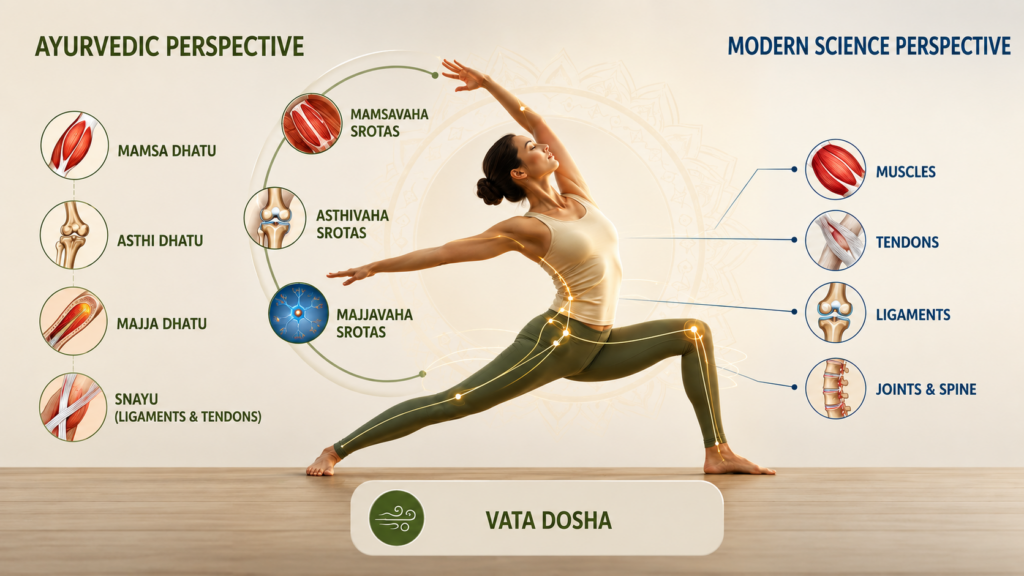
In Ayurveda strength of kapha dosha, mansa, meda, asthi and majja dhatus are responsible for flexibility, strength and agility.
In modern science, flexibility is understood as the ability of muscles, tendons, ligaments, joints, and the spine to move through their full range of motion. Ayurveda does not describe flexibility as a separate physiological parameter; rather, it is viewed as the outcome of the proper nourishment, balance, and functioning of various Dhatus (body tissues), Srotas (body channels), and Doshas.
Body tissues and dosha (Neej Hetu)
1. Role of Mamsa Dhatu (Muscle Tissue)
Mamsa Dhatu provides strength, stability, and support to joints and bones. Well-nourished Mamsa Dhatu allows muscles to remain strong yet pliable. Depletion (Mamsa Kshaya) leads to weakness and instability, while excessive accumulation may cause stiffness and restricted movement.
2. Role of Asthi Dhatu (Bone Tissue)
Asthi Dhatu forms the structural framework of the body. Healthy bones and joints are essential for normal range of motion. According to Ayurveda, the joints (Sandhi) are considered important sites of Asthi Dhatu. Degeneration of Asthi Dhatu, commonly associated with aggravated Vata, results in stiffness, cracking joints, reduced mobility, and deformities.
3. Role of Majja Dhatu (Marrow and Nervous Tissue)
Majja Dhatu fills the cavities of bones and nourishes the nervous system. Proper Majja contributes to smooth neuromuscular coordination and joint lubrication. Majja Kshaya may manifest as weakness, tremors, instability, and impaired movement.
4. Role of Snayu (Ligaments and Tendons)
Although Snayu are considered Upadhatus and supporting structures, they are critically important for flexibility. Classical texts describe Snayu as structures that bind bones, muscles, and joints together. Healthy Snayu permits controlled movement while maintaining stability. Vitiated Vata often causes Snayu stiffness, contractures, and restricted movement.
5. Mamsavaha Srotas
The Mamsavaha Srotas are responsible for the nourishment and maintenance of muscle tissue. Their roots (Moola) are described as Snayu and Twak. When these channels function properly, muscles remain healthy and flexible. Srotodushti may produce muscle tightness, heaviness, stiffness, and impaired movement.
6. Asthivaha Srotas
The Asthivaha Srotas nourish bones and joints. Their roots are described as Meda and Jaghana Pradesh (pelvic region). Proper functioning ensures healthy bones, joints, and supportive structures necessary for mobility. Disturbance leads to degeneration, pain, crepitus, and reduced flexibility.
7. Majjavaha Srotas
These channels nourish Majja Dhatu and contribute to neuromuscular coordination. Their impairment can affect movement efficiency, balance, and flexibility.
8. Importance of Vata Dosha
Among the three Doshas, Vata, especially Vyana Vayu, is the principal force governing all bodily movements. Balanced Vata facilitates smooth and coordinated motion. Aggravated Vata causes stiffness (Stambha), contraction (Akunchana), pain, and restricted mobility.
Flexibility as a Sign of Dhatu and Srotas Health
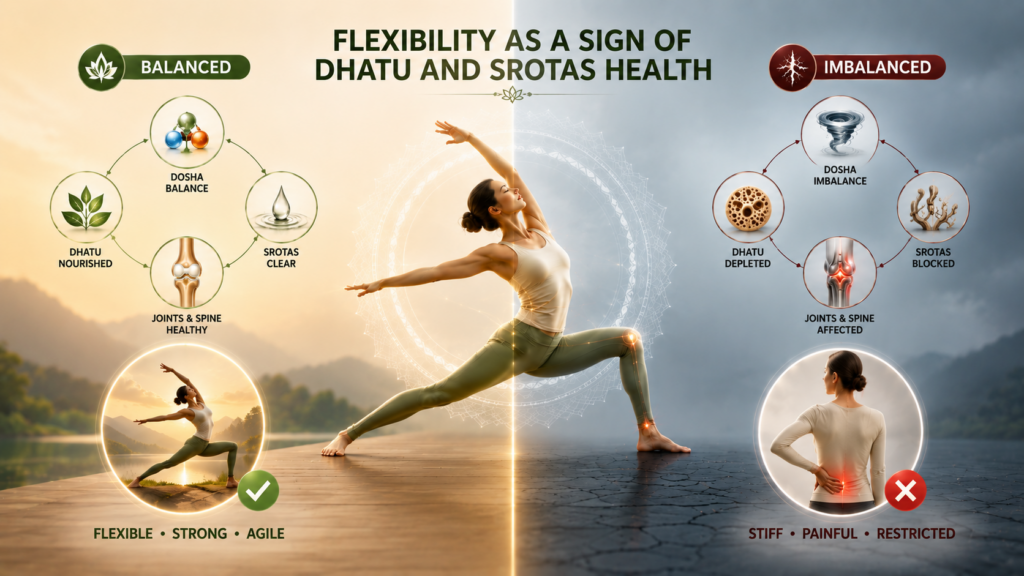
Also, considering dosha kapha dosha and its attributes like mrudu/ smooth, snigdha- unctuous are helpful for flexibility. But excess leads to stiffness, oedema, and inflammation of joints.
Opposite to that vata which is ruksha- dry, khar- rough, chala- mobile are responsible for movements but in aggravated state lead to arthritis, paraplegia, sciatica, muscle pain and stiffness.
Joint flexibility depends on the health of cartilage, synovial fluid, surrounding muscles, and connective tissues. Well-functioning joints allow effortless movement, reduce wear and tear, and help prevent conditions such as osteoarthritis. The spine, composed of vertebrae, discs, ligaments, and muscles, requires flexibility to permit bending, twisting, and proper posture. A flexible spine distributes mechanical stress efficiently and decreases the risk of back pain.
More Factors Responsible for Flexibility in the Human Body – (Aaagantauj hetu)
1. Age and Genetics
Children are generally more flexible than older adults because connective tissues become stiffer with age. Genetic factors also influence tissue elasticity and joint mobility.
2. Physical Activity and Exercise
Regular stretching, yoga, mobility training, and physical activity maintain tissue elasticity and joint function. Sedentary lifestyles lead to stiffness and reduced flexibility.
3. Hydration and Nutrition
Water maintains the health of muscles, fascia, discs, and joints. Adequate protein, vitamins, minerals, and healthy fats support connective tissue repair and flexibility.
4. Injury, Disease, and Inflammation
Previous injuries, arthritis, chronic inflammation, and musculoskeletal disorders can restrict movement by causing pain, scar tissue formation, and structural changes.
Thus, flexibility is a reflection of the combined health of muscles, tendons, ligaments, fascia, joints, spine, nervous system, and overall lifestyle. Maintaining these factors through proper exercise, nutrition, hydration, and healthy habits helps preserve mobility and functional independence throughout life.
From an Ayurvedic viewpoint, flexibility is not merely the ability to stretch. It reflects:
- Balanced kapha. And its guna like snigdha, shlakshna, mrudu
- Balanced shleshak kapha at joints sites
- Proper nourishment of Mamsa, Asthi, and Majja Dhatus
- Healthy functioning of Mamsavaha, Asthivaha, and Majjavaha Srotas
- Integrity of Snayu and Sandhi
- Adequate lubrication and nourishment of tissues.
- Balanced Vata Dosha
Therefore, flexibility can be considered a manifestation of Dhatu Sara (tissue excellence), unobstructed Srotasa ( No aam) , and harmonious Dosha function. A person with well-nourished tissues and balanced Vata naturally exhibits ease of movement, good posture, joint mobility, and physical resilience.
Learn Flexibility score from nadi Tarangini analysis
Nadi Tarangini gives a flexibility score based on the fundamentals of dosha, dhatu and its attributes.
In nadi pariksha, analysing dosha, and its attributes. Considering Kapha attributes like Snigdha, mrudu forms flexibility of muscles, ligaments. Pitta guna like Snigdha from nadi also related to flexibility which forms new cells.
Flexibility score is given in 0-100 , it is 10-30 as low flexibility, 40-70 as moderate flexibility and 80-100 as good flexibility.
Ayurveda views flexibility (Laghava, Mriduta, Chalatva, and Mardava) as an expression of balanced Doshas, healthy Dhatus, unobstructed Srotas, and proper tissue qualities (Gunas). The ability of muscles, tendons, ligaments, joints, and the spine to move smoothly depends primarily on the state of Vata Dosha, but Kapha and Pitta also contribute significantly.
Health expertise , wellness practitioner should consider following parameters-
- Balanced Vyana Vayu.
- Adequate Shleshaka Kapha.
- Well-nourished Mamsa, Asthi, and Majja Dhatus.
- Healthy Snayu and Sandhi.
- Predominance of Mridu, Snigdha, Laghu, Sara, and Shlakshna qualities.
- Absence of excessive Ruksha, Khara, Kathina, and Sheeta qualities.
Therefore, flexibility in Ayurveda is not merely the ability to stretch a muscle. It is a manifestation of harmonious Vata movement, adequate Kapha lubrication, proper Dhatu nourishment, healthy Srotas, and a balanced expression of the fundamental Gunas throughout the body.