
How to calculate Bala through Nadi Pariksha using Nadi Trarangini
How to calculate Bala through Nadi Pariksha using Nadi Trarangini
 Vaidya Tejaswini Bhale
Nadi Pariksha (Pulse Diagnosis) with Classical Ayurvedic Attributes
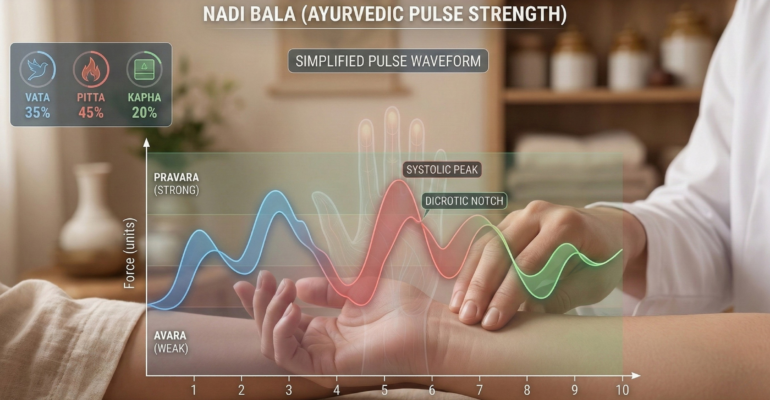
This is an important distinction. In the context of Nadi Pariksha, the term Bala refers to the force, strength, or amplitude of the pulse, not directly to the broader concept of patient strength (Rugna Bala) used in Dashavidha Pariksha.
Ancient texts that discuss Nadi Pariksha—particularly Sharangadhara Samhita, Bhavaprakasha, and Yogaratnakara—describe Bala as one of the characteristics of pulse assessment, along with Gati (movement), Vega (rate), Tala (rhythm), and other qualities.
Bala in Nadi Pariksha
When examining the pulse, the physician evaluates:
- Pulse force
- Fullness of the pulse
- Resistance felt under the fingers
- Depth and stability
- Ease of palpation
A pulse may be:
Pravara Bala (Strong Pulse)
- Full and forceful
- Easily palpable
- Stable and well sustained
- Indicates good Ojas, strong Dhatus, and better vitality
Madhyama Bala (Moderate Pulse)
- Moderate force and volume
- Regular and stable
- Suggests average strength and physiological balance
Avara Bala (Weak Pulse)
- Thin, feeble, or thread-like
- Difficult to perceive
- Easily collapses under finger pressure
- May indicate depleted Dhatus, low Ojas, chronic disease, exhaustion, or advanced age
Bala According to Dosha Dominance
Some traditional Nadi texts associate pulse strength with Doshic predominance:
| Dosha | Pulse Bala |
|---|---|
| Vata | Low (Alpa Bala) |
| Pitta | Strong (Prabala Bala) |
| Kapha | Moderate to Strong (Madhyama Bala) |
Vata pulse is often described as lighter and weaker, Pitta pulse as stronger and more forceful, and Kapha pulse as steady, broad, and moderately forceful.
Relation to Rugna Bala
Traditional Vaidyas did not assess patient strength solely from pulse force. A strong pulse was considered one indicator of vitality, but it had to be correlated with:
- Prakruti
- Sara
- Samhanana
- Satva
- Age (Vaya)
- Agni
- Disease severity (Vyadhi Bala)
Only after integrating all these findings would the physician determine the patient’s true Rugna Bala.
Classical Clinical Interpretation
Many traditional Nadi practitioners summarize the concept as:
“Nadi Bala reflects the strength of the life force and/ or disease expressed through the pulse, whereas Rugna Bala reflects the overall strength of the individual.”
Thus, in ancient Nadi Pariksha, Bala is primarily a pulse characteristic (force and amplitude), while in Ayurvedic diagnosis as a whole, Bala is a much broader measure encompassing physical, mental, and immunological strength along with symptoms or illnesses related severity.
Core Pulse Attributes used in Nadi Pariksha
In classical Ayurvedic interpretation, pulse is assessed using:
1. Vyadhi Bala (Strength)
- Strong (prabala) / Medium (madhyam bala)/ Weak (Avara bala) Vitiated dosha level reflection)
- In Nadi Tarangini levels of Vyadhi bala are given in ranges of 10-30 as Avara/less, 40-70 as Madhyam/ moderate and Prabala/Strong as 80-100.
2. Gati (Movement / Flow)
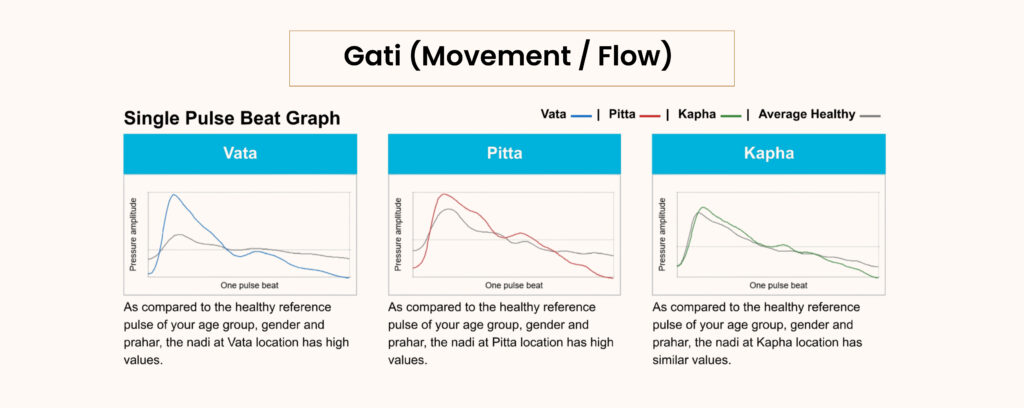
- Sarpa gati (snake-like – Vata)
- Manduka gati (frog-like – Pitta)
- Hansa gati (Swan-like – Kapha)
3. Guna (Qualities) of Pulse
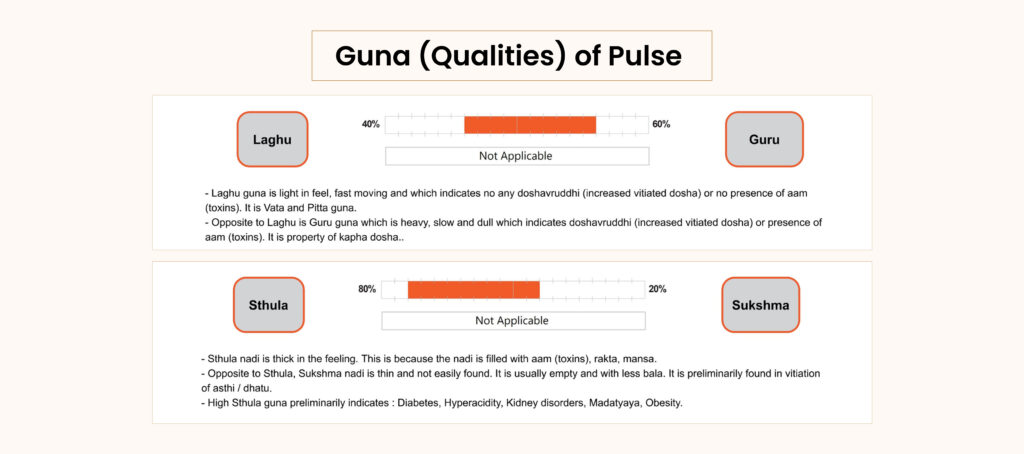
| Sanskrit term | Meaning |
|---|---|
| Sthula | Gross, heavy, thick pulse |
| Sukshma | Fine, subtle pulse |
| Guru | Heavy, sluggish |
| Laghu | Light, quick |
| Snigdha | Oily, smooth, lubricated |
| Ruksha | Dry, rough |
| Manda | Slow |
| Tikshna | Sharp, intense |
| Sthula | Bulky |
| Sukshma | Subtle |
Condition-wise Nadi + Ayurvedic Gunas
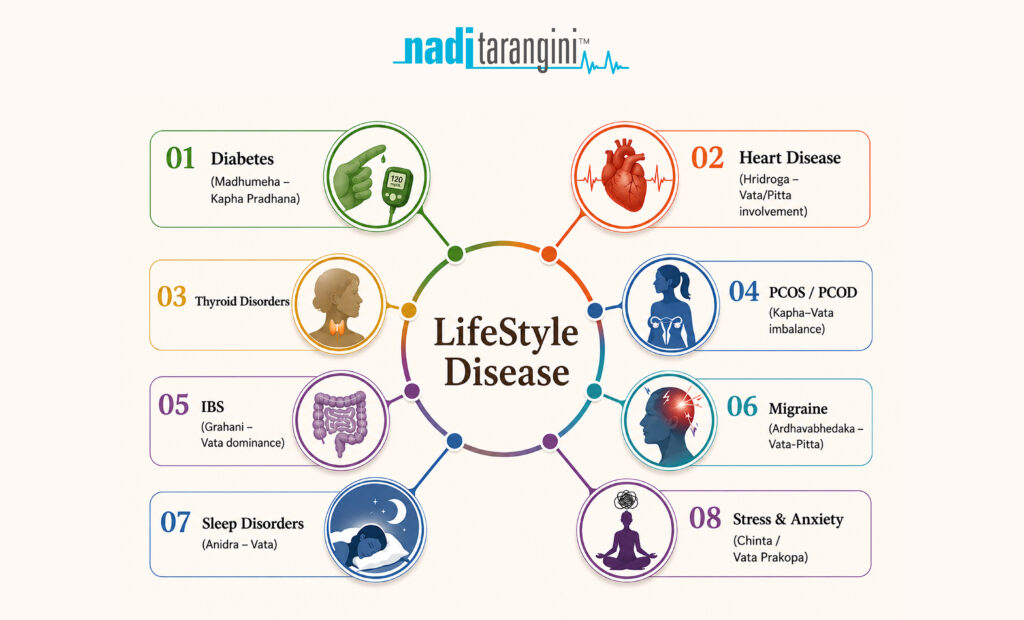
1. Diabetes (Madhumeha – Kapha Pradhana)
Nadi profile
- Gati: Hansa- sarpa gati
- Guna:
- Guru (heavy)
- Sthula (gross)
- Snigdha (oily)
- Manda (slow)
- Chronic stage → more Ruksha (dry depletion) due to dhatu kshaya
2. Heart Disease (Hridroga – Vata/Pitta involvement)
Nadi profile
- Gati:
- Vata → Sarpa gati (irregular, wavy)
- Pitta → Manduk Tikshna, forceful movement
- Jalauka gati ( Leech )
- Guna:
- Chala (unstable)
- Tikshna (sharp)
- Sukshma (thin in depletion cases)
- sometimes Guru in Kapha involvement
3. Thyroid Disorders
Hyperthyroid (Pitta–Vata)
- Gati: Tikshna + Chala (fast, jumping)
- Guna:
- Laghu (light)
- Tikshna (sharp)
- Sukshma (fine)
- Ushna quality dominance
Hypothyroid (Kapha- pitta)
- Gati: Manda (slow, dull),
- Guna:
- Guru (heavy)
- Sthula (thick)
- Snigdha (oily)
- Sthira (but inert)
4. PCOS / PCOD (Kapha–Vata imbalance)
- Gati: Manda + Chala mix (sluggish but irregular)
- Guna:
- Guru (heavy metabolic sluggishness)
- Snigdha (Kapha excess)
- Chala (hormonal instability)
- Sthula (tissue accumulation tendency)
5. IBS (Grahani – Vata dominance)
- Gati: Sarpa gati (snake-like irregular flow)
- Guna:
- Ruksha (dryness – gut irritation)
- Sukshma (thin, sensitive pulse)
- Chala (unstable rhythm)
- Laghu (light but weak containment)
6. Migraine (Ardhavabhedaka – Vata-Pitta)
- Gati: Tikshna + Chala
- Guna:
- Tikshna (sharp intensity)
- Sukshma (fine nerve sensitivity)
- Ushna (heat tendency)
- Chala (instability)
7. Sleep Disorders (Anidra – Vata)
- Gati: Sarpa gati (restless movement)
- Guna:
- Ruksha (dry nervous system)
- Laghu (lightness, inability to ground)
- Chala (hyperactivity)
- Sukshma (over-sensitive pulse)
8. Stress & Anxiety (Chinta / Vata Prakopa)
- Gati: Sarpa gati (erratic, jumping)
- Guna:
- Chala (unstable showing palpitations )
- Ruksha (dry nervous tension)
- Laghu (light, airy imbalance)
- Tikshna (Pitta overlay during anxiety)
Quick Ayurvedic Mapping Summary
| Condition | Gati | Bala | Dominant Guna |
|---|---|---|---|
| Diabetes | Hansa- Sarpa | Manda | Guru, Sthula, Snigdha |
| Heart disease | Sarpa-manduka/ Jaluka | Vishama | Chala, Tikshna |
| Thyroid (hyper) | Manduka-sarpa Sarpa | Vishama | Tikshna, Laghu, Ushna |
| Thyroid (hypo) | Hansa- Manduka | Alpa | Manda, Guru, Sthira |
| PCOS | Sarpa- Hansa Manda-Chala | Madhyama ↓ | Guru, Snigdha |
| IBS | Sarpa | Alpabala | Ruksha, Chala |
| Migraine | Sarpa-manduka | Madhyama | Tikshna, Ushna |
| Insomnia | Sarpa | Alpa | Ruksha, Laghu |
| Anxiety | Sarpa | Vishama | Chala, Ruksha |
When assessing Bala, Ayurvedic physicians consider age and habitat along with Prakruti, season, diet, mental strength, and disease status. A young adult living in a favourable environment may naturally possess higher Bala, whereas a child, elderly individual, or person living under challenging environmental conditions may require additional support to maintain strength and vitality to fight against disease.
Clinical Importance of Bala
Assessment of Bala through Nadi pariksha helps to confirm:
- Prognosis of disease
- Root cause of any disease
- Design treatment protocol
Nadi pariksha helps practitioners to understand the severity of diseases and symptoms . It will further help him / her in their consultation and counselling of health seekers.
Nadi tarangini, patented sensor based tech and software will assist practitioners to find , analyse and understand Bala to do better diagnosis and create personalised treatment plans. It also helps to give evidence practice and to grow more belief and trust in practitioners and the science.