
From Panchakarma Centres to Wellness Resorts: How Nadi Tarangini Fits into Modern Healing Ecosystems
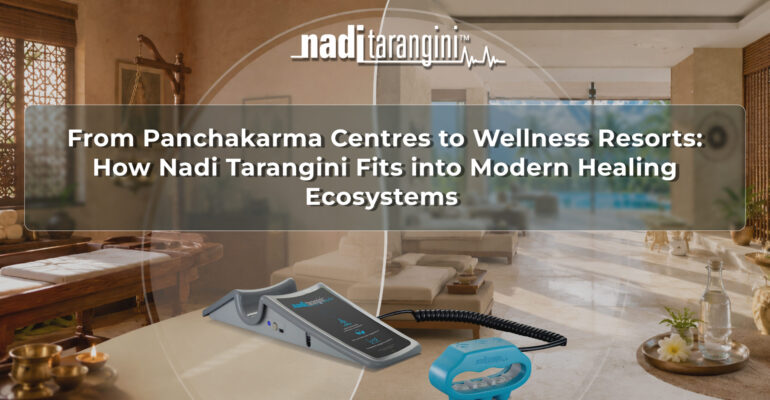
From Panchakarma Centres to Wellness Resorts: How Nadi Tarangini Fits into Modern Healing Ecosystems
 Dr. Gayatri Mulye
Ayurveda is evolving beyond the traditional boundaries of clinics and Panchakarma centres, establishing a growing presence across wellness resorts, preventive healthcare programs, corporate wellness initiatives, therapeutic retreats, and integrative health centres.
As these settings increasingly emphasize personalized, preventive, and measurable approaches to well-being, technologies such as Nadi Tarangini can provide a structured layer of Ayurvedic assessment including Nadi pariksha.
By digitally capturing pulse waveforms and organizing pulse-related observations, Nadi Tarangini can support practitioners in documenting individual assessments, developing personalized wellness plans, monitoring changes over time, and maintaining continuity across wellness programs. In this way, it can serve as a bridge between traditional Ayurvedic clinical observation and the structured, data-oriented requirements of modern wellness ecosystems.
Ayurveda Meets the Modern Wellness Ecosystem
Traditional Ayurveda places considerable importance on understanding an individual’s unique constitution, current imbalances, lifestyle, digestion, sleep, mental state, and other factors.
In a traditional clinical setting, an experienced practitioner can integrate these observations through direct consultation and examination. However, modern wellness environments often work with larger numbers of visitors and offer programs that may extend over several days or weeks.
This creates a practical need for a systematic approach to assessment and documentation.
Nadi Tarangini can support this process by digitally capturing pulse waveforms and presenting structured observations that practitioners can consider alongside their conventional Ayurvedic assessment.
From Panchakarma Assessment to Wellness Resorts: Expanding the Role of Nadi Tarangini
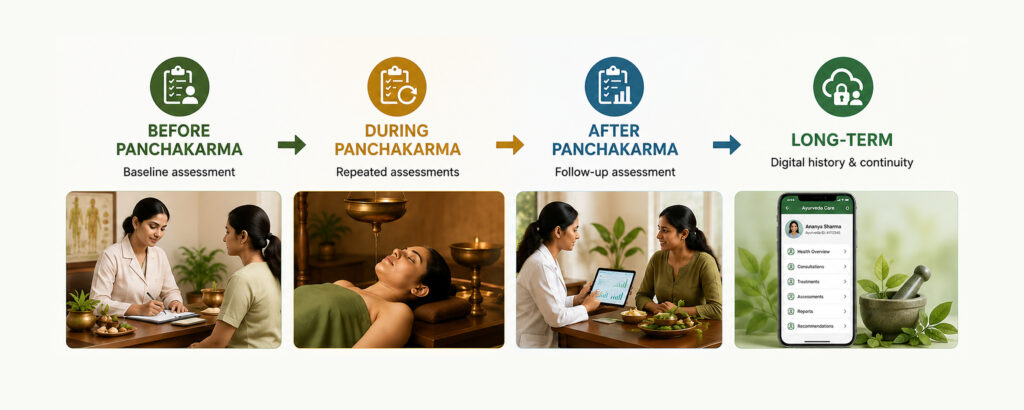
Nadi Tarangini can be useful in Panchakarma centres as a structured assessment and follow-up tool, particularly when practitioners want to document changes before, during, and after therapies.
In wellness programs also a person may feel better after a program, but subjective experiences can be difficult to document systematically. Digital records can help create a timeline of assessments. Repeated assessments can help practitioners compare observations over time and discuss the individual’s progress in a more structured manner.
A Valuable Tool for Modern Panchakarma Centres
For Panchakarma centres, Nadi Tarangini can potentially become part of a broader digital workflow.
Instead of keeping assessment, therapy, and follow-up information disconnected, centres can work toward creating a more organized patient record.
Baseline assessment before Panchakarma
A pulse assessment can be recorded before starting the treatment.
It can provide structured information that practitioners may consider alongside history, examination, Prakriti, Vikruti, and other Ayurvedic assessments.
This creates a documented baseline for comparison.
Monitoring changes during the treatment
The process of Panchakarma involves multiple stages—Purvakarma, Pradhanakarma, and Paschatkarma.
Nadi Tarangini can help maintain repeated digital pulse records at relevant stages, allowing practitioners to observe changes over time rather than relying only on memory or subjective notes.
Supporting Dosha assessment
Digital pulse analysis can be used as an additional aid while assessing Vata, Pitta, and Kapha patterns. It should complement, rather than replace, the physician’s clinical judgement and traditional Nadi Pariksha.
Treatment-response documentation
Before-and-after records can help practitioners document how a patient changes following therapies such as Abhyanga, Swedana, Vamana, Virechana, Basti, or Nasya, depending on the treatment plan.
Better patient communication
Visualized pulse reports can make it easier to explain the assessment and follow-up process to patients. Showing changes across multiple visits can make the treatment journey more understandable.
Longitudinal patient records
Panchakarma centres can maintain digital records of repeated assessments. Over time, these records may help identify patterns related to different therapies, patient profiles, seasonal changes, and treatment responses.
Research and documentation
Structured and repeatable records can be valuable for institutional studies and clinical research. Panchakarma centres can potentially use aggregated data to study treatment outcomes and generate hypotheses for further research.
Bringing Personalization to Wellness Resorts
Wellness resorts are evolving beyond relaxation and rejuvenation to offer more personalized, preventive, and holistic health experiences.
Wellness resorts increasingly offer customized experiences involving Ayurveda, yoga, meditation, nutrition, massage, Panchakarma, fitness, and lifestyle programs.
Two individuals may arrive at the same resort with very different constitutions, routines, stress levels, dietary habits, and wellness goals.
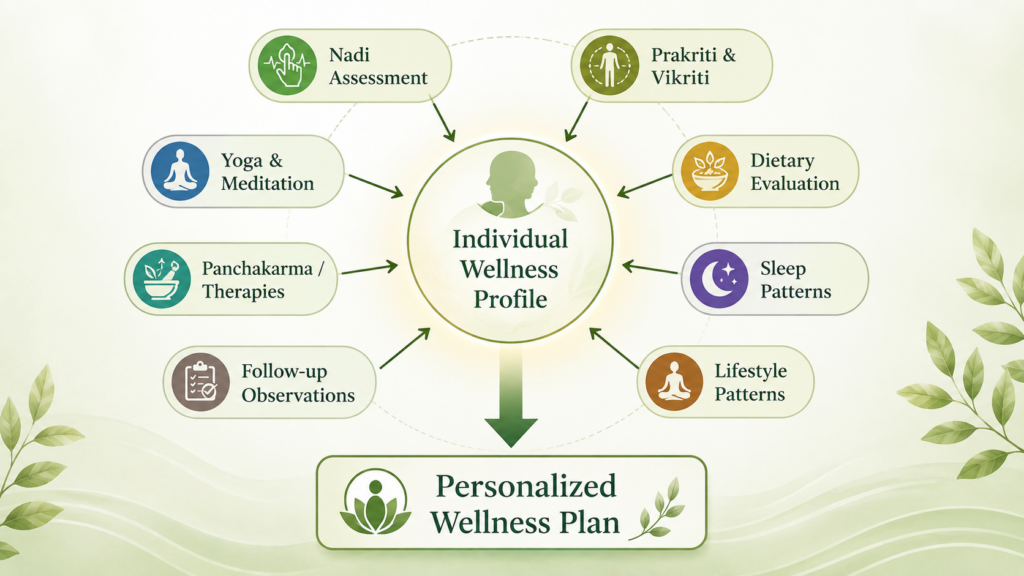
Nadi Tarangini can support the assessment process by providing structured pulse-related observations that practitioners can consider while designing individualized programs.
These observations can then be combined with:
• Ayurvedic consultation
• Prakriti and Vikriti assessment
• Dietary evaluation
• Sleep and lifestyle patterns
• Yoga and meditation practices
• Panchakarma or other therapies
• Follow-up observations
This creates a more integrated approach to wellness planning.
Creating Continuity Beyond the Resort
A major opportunity lies in extending wellness beyond the physical stay.
A guest may spend a few days or weeks at a wellness resort, but maintaining healthy habits after returning home is often the real challenge.
Digital records can support continuity by allowing practitioners to maintain an assessment history and use previous observations during subsequent consultations.
This transforms a one-time wellness experience into an ongoing relationship between the individual and the wellness provider.
Ayurvedic concepts such as Dosha, Prakriti, Vikriti, Agni, and other clinical observations can sometimes be difficult for newcomers to understand.
A structured digital report can provide practitioners with visual aid during consultations. Instead of relying entirely on verbal explanations, practitioners can use the report as a starting point for discussing observations, lifestyle patterns, and personalized recommendations.
This can make the consultation more interactive and easier for wellness participants to follow.
Beyond Individual Wellness: Building Institutional Data
There is another important dimension-research and evidence building.
Wellness centres and Ayurvedic institutions generate valuable clinical observations every day. However, when these observations remain only in paper files or individual practitioner notes, it becomes difficult to analyze broader patterns.
Structured digital records can create opportunities for evidence based research.
Nadi Pariksha is traditionally an observational clinical practice that depends on experience, context, and interpretation.
A digital system can capture and organize pulse-related signals, but the broader clinical picture still requires professional judgment.
This combination can help modern Ayurvedic institutions preserve traditional approaches while adapting them to contemporary expectations around documentation, personalization, and continuity of care.
The evolution from traditional Panchakarma centers to modern wellness resorts reflects a broader change in how people approach health.
People are increasingly looking for personalized, preventive, and continuous wellness experiences rather than isolated treatments.
For these emerging healing ecosystems, technologies such as Nadi Tarangini can serve as a bridge between traditional Ayurvedic assessment and modern digital healthcare workflows.
Its potential role extends beyond a single pulse reading. It can become part of a larger ecosystem involving assessment, personalized wellness planning, digital records, follow-up, practitioner communication, and research.
The future may not be about choosing between traditional Ayurveda and modern technology.
It may be about bringing the two together thoughtfully using technology to make Ayurvedic observation more structured, measurable, documentable, and connected, while keeping the practitioner and the principles of Ayurveda at the centre of care.
Summary
The evolution of Ayurveda from traditional Panchakarma centres to modern wellness resorts creates new opportunities for technology-assisted assessment and personalized care. Nadi Tarangini can support this transition by providing a structured approach to digital pulse assessment, documentation, follow-up, and longitudinal record-keeping.
Nadi Tarangini can act as a bridge between the traditional wisdom of Nadi Pariksha and the structured, personalized, and data-oriented needs of modern wellness ecosystems while keeping Ayurvedic principles and practitioner expertise at the centre of care.