
Ama in Ayurveda: Concept, Classical References and Nadi Assessment through Nadi Tarangini
Ama in Ayurveda: Concept, Classical References and Nadi Assessment through Nadi Tarangini
 Vaidya Tejaswini Bhale
Introduction
Among all pathological concepts described in Ayurveda, ama (आम) is a very crucial part. Almost every chronic disease, metabolic disorder, inflammatory condition, autoimmune disease, and degenerative disorder involves ama either as a causative factor or as a disease-promoting factor.
Acharya Charaka states that impaired Agni (digestive and metabolic fire) is the root cause of disease. When Agni loses its normal function, food is not completely transformed into healthy nutrition. Instead, an immature, heavy, sticky and toxic substance called ama is formed.
Thus,
Healthy Agni → Proper Dhātu formation → Ojas → Health
whereas
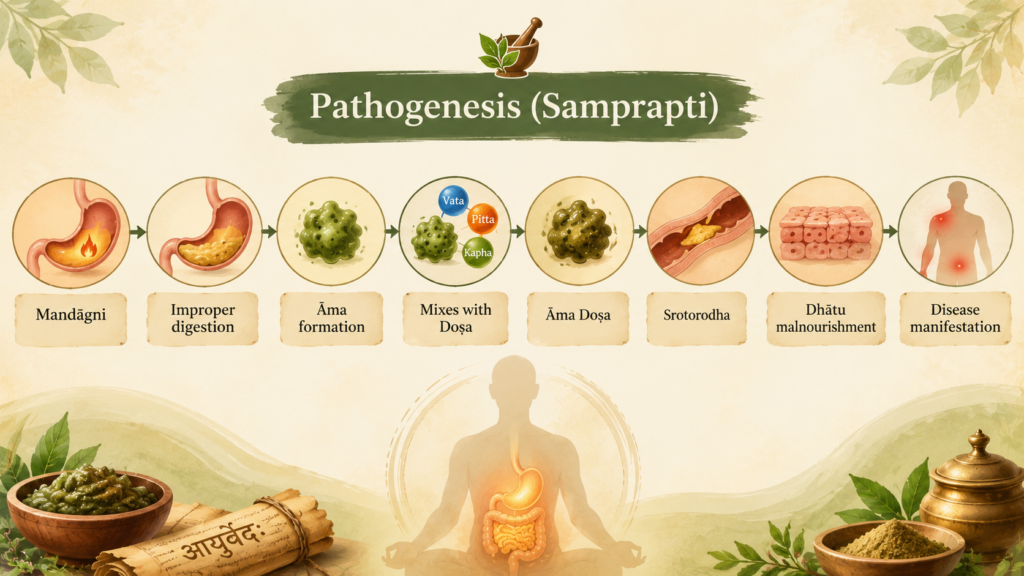
Mandāgni → Āma → Srotorodha → Doṣa vitiation → Disease
In Charak Samhita Aam is defined as,
ऊष्मणोऽल्पबलत्वेन धातुमाद्यमपाचितम्।
दुष्टमामाशयगतं रसमामं प्रचक्षते॥
When digestive fire (Agni) becomes weak, the first product of digestion (Āhāra Rasa) remains incompletely processed. This improperly digested material becomes impure and is called aam or toxins.
अपक्वो रसः आमः
“Improperly digested nutritional essence is called ama.”
- Aam means Unripe, Undigested, Immature, Unprocessed and toxic due to incomplete transformation
Thus, ama literally means that which has not undergone complete transformation.
Importance of Agni in Formation of Āma
Acharya Charaka states
रोगाः सर्वेऽपि मन्देऽग्नौ।
Almost all diseases originate from impaired Agni, Mandagni or vishamagni.
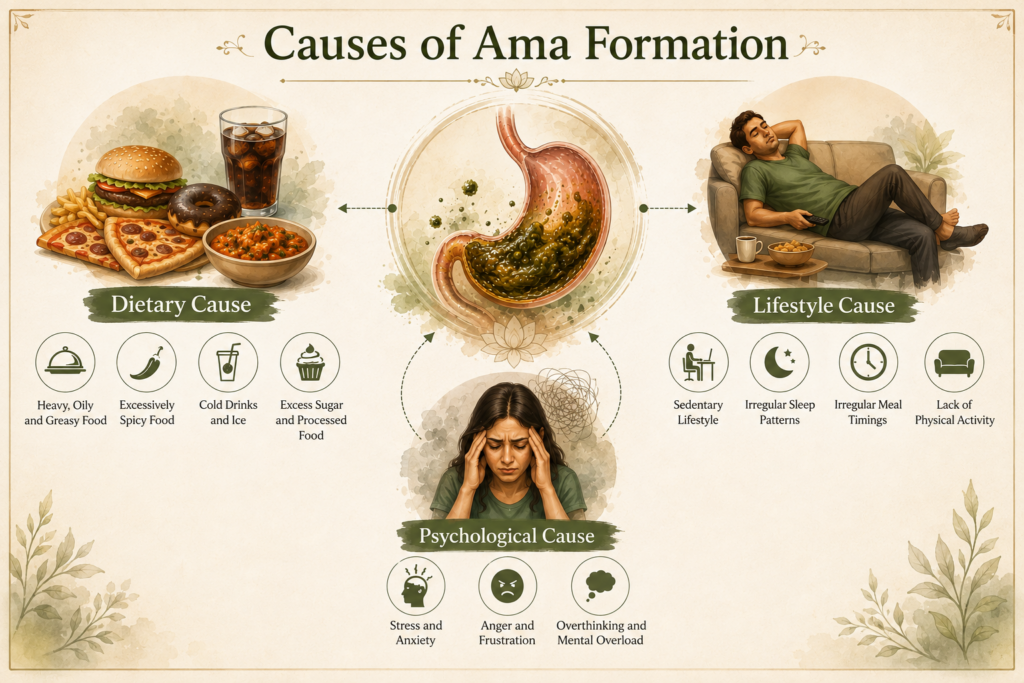
- Dietary Causes
- Atyashana- Overeating
- Adhyashana- Eating before previous meal digests
- Guru aahar- Heavy food
- Ati sheeta aahar- Cold food
- Ati snigddha aahar- Oily food in excess
- Ati dugdha aahar- Excess dairy products
- Viruddha Ahara- opposite to rasa, veerya, guna, desha, Sanskar, kaal, prakruti
- Paryushitanna-
- Ati Madhur rasa aahar- Excess sweets
- Lifestyle Causes
- Bhojan pashchat nidra- Sleeping immediately after meals
- Deevaswap- Day sleep
- Avyayam- Lack of exercise
- Chinta, Vishad- Mental stress
- Vega vidharan- Suppression of natural urges
- Sedentary lifestyle
- Psychological Causes
- Chinta- Anxiety
- BHay- Fear
- Krodha – Anger
- Dukha/ Vishad- Excess grief
disturb Agni and eventually produce Āma.
Properties (Guṇa) of ama
Although classics describe ama indirectly, its functional qualities are understood as:
| Guna | Effect |
|---|---|
| Guru | Heaviness |
| Snigdha | Sticky |
| Picchila | Slimy |
| Manda | Slow metabolism |
| Sthira | Stagnation |
| Styan | Dense |
| Avila | Turbid |
| Durgandha | Foul smell |
| Apakva | Immature |
| Sanga-kari | Obstructive |
How Aam forms in the body?
Annavaha srotas/ Maha srotas or digestive system is the first site of aam formation.
Pathogenesis (Samprapti)
Classical Symptoms of Āma
Acharya Charaka describes the general features.
स्रोतोरोधो बलभ्रंशो गौरवं अनिलमूढता।
आलस्यं अपक्तिः निष्ठीवनं मलसंगः अरुचिः क्लमः॥
Symptoms include:
- Aruchi- Loss of taste
- Bala nash- Weakness
- Gaurav- Heaviness
- Vata vikruti- Improper movement of Vata
- Aalsya- Laziness
- Apachan- Indigestion
- Lalastrava- – Excess salivation
- Malavashtambha- constipation
- Daurbalya- Fatigue
- Srotorodha- Obstruction of channels
How to treat amavastha
Fresh undigested toxins are treatable with laghan, deepan and pachan means light food to consume, do fasting, and drink warm water.
Chronic Āma
Deepan, pachan – Long-standing metabolic dysfunction with medicines.
Āma and Modern Medicine
Although Āma has no exact biomedical equivalent, it may broadly correlate with processes such as:
- Incomplete metabolism
- Accumulation of inflammatory mediators
- Endotoxins
- Oxidative stress
- Immune dysregulation
- Gut dysbiosis
- Increased intestinal permeability (“leaky gut”)
- Metabolic waste accumulation
These comparisons are conceptual rather than direct one-to-one equivalences.
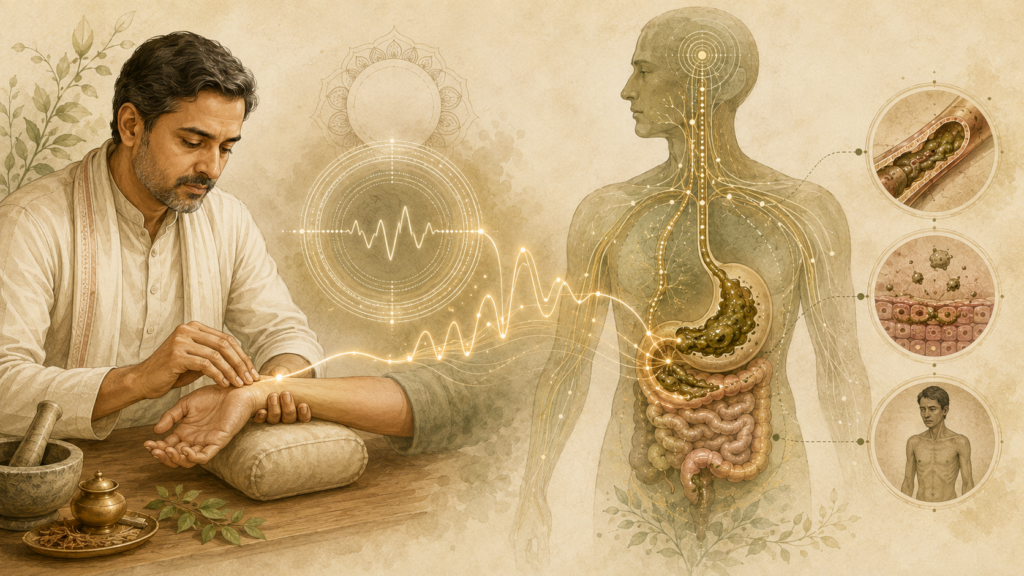
Analysis of Āma through Nāḍī Parīkṣā
Classical Perspective
The major Ayurvedic classics (Charaka, Suśruta, and Aṣṭāṅga Hṛdaya) describe examination methods such as Aṣṭavidha pariksha and dashavidha pariksha but detailed pulse diagnosis evolved more fully in later Nadi vigyan literature. Therefore, pulse features of Āma are based on texts like Nadi Vigyan and long-standing clinical traditions rather than explicit descriptions in the principal Saṃhitās.
A Vaidya evaluates not only the pulse but also integrates it with:
- Darshan (inspection)
- Sparshan (palpation)
- Prashna (history)
- Jihva (tongue)
- Mala
- Mutra
- Agni
- Bala
Pulse findings alone are not considered sufficient for diagnosing Āma but are very useful to do correct disgnosis of state of diseases. Whether the aama is present in aamashaya or in dhatus or in dosha are analysed through nadi along with clinical examination of a person.
Nadi Characteristics of Āma
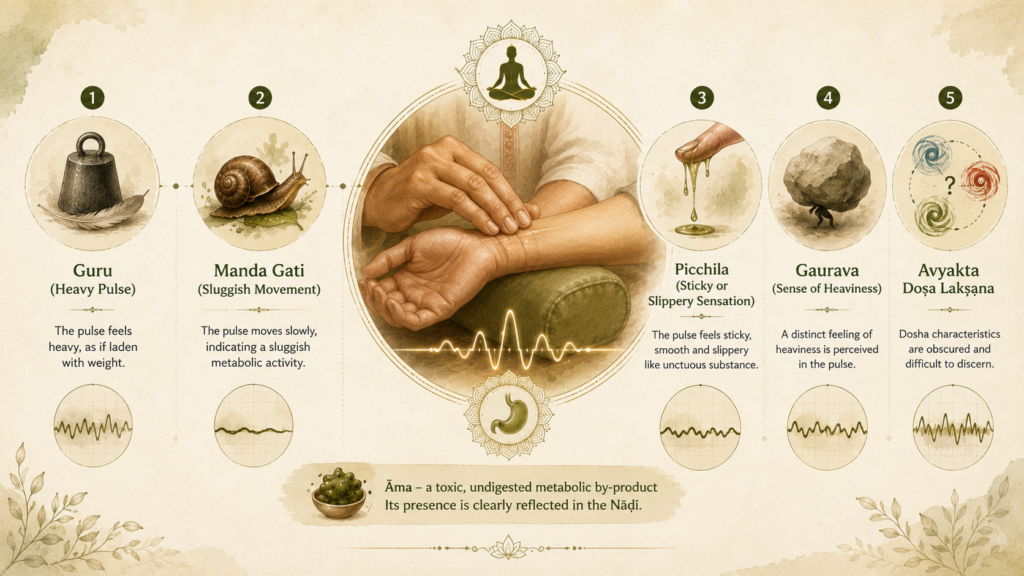
Traditional Nadi practitioners often describe the following features when Āma is present:
1. Guru (Heavy Pulse)
The pulse feels weighted, dull, and lacks the lightness of balanced physiology, reflecting the guru quality of Āma.
2. Manda Gati (Sluggish Movement)
The pulsation appears slow to rise and fall, corresponding to impaired Agni and reduced metabolic activity.
3. Picchila (Sticky or Slippery Sensation)
The pulse may feel smooth, viscous, or coated beneath the examining fingers, mirroring the picchila (slimy)
4. Gaurava (Sense of Heaviness)
Rather than a crisp, vibrant impulse, the pulse conveys a sensation of density or burden.
5. Avyakta Doṣa Lakṣaṇa
In uncomplicated conditions, Vata, Pitta, or Kapha qualities may be distinctly appreciable. With aam, these characteristics can become obscured or mixed, making the pulse less clearly differentiated.
6. Reduced Clarity and Rhythm
Traditional practitioners describe the pulse as lacking brightness or vitality. Its rhythm may feel muted or irregular because the normal movement of dosha is hindered by Srotorodha/ blockages.
Differentiating Nirāma and Sāma Nadi
| Feature | Nirāma | Sāma (Āma present) |
|---|---|---|
| Pulse quality | Clear, distinct | Dull, clouded |
| Rhythm | Regular | Less distinct, sometimes variable |
| Touch | Crisp | Heavy, sticky, sluggish |
| Doṣa identification | Easier | Often obscured or mixed |
| Vitality | Bright and responsive | Reduced, burdened |
In nadi Tarangini analysis, nadi is described as Saam or Niraam considering all above factors. Also, it is mentioned as Toxins , present or absent.
Now with Clinical Integration wellness practitioners can find out treatment plans based on this.
A skilled Vaidya never interprets pulse findings in isolation. Suspicion of aam on nadi pariksha is corroborated by associated signs such as:
- Thick tongue coating- Saam jivha
- Poor appetite- kshudhamandya
- Heaviness- anga gaurav
- Fatigue- bala hani
- Sticky stools- saam mala
- Foul odor- durgadndhi
- Indigestion- apachana
- Lethargy- aalasya
- Joint stiffness- sandhi graha
- Reduced enthusiasm- utsah hani
This integrated approach aligns with the Ayurvedic principle of Yukti (rational clinical reasoning), where multiple sources of evidence are synthesized before arriving at a diagnosis.
Thus, aam, is one of Ayurveda’s foundational concepts, representing the accumulation of incompletely digested and improperly transformed material due to impaired Agni. Its qualities—guru, manda, snigdha, picchila, and srotorodhakara—lead to obstruction of bodily channels, vitiation of Doṣas, and impairment of Dhatus. While the principal Ayurvedic classics do not explicitly define pulse characteristics of ama, traditional Naḍi Pariksga describes a heavy, sluggish, sticky, and less distinct pulse that reflects these underlying qualities. In practice, an experienced Vaidya combines pulse examination with assessment of Agni, tongue, digestion, mala, and other clinical findings to identify ama accurately and formulate appropriate treatment aimed at ama-pachana, Agni-deepana, and restoration of physiological balance.