
How AI Is Changing Ayurvedic Pulse Diagnosis – Shaping the Future of Ayurveda
How AI Is Changing Ayurvedic Pulse Diagnosis – Shaping the Future of Ayurveda
 Dr. Gayatri Mulye
Ayurveda has long recognized Nadi Pariksha (pulse examination) as an important component of clinical assessment. Traditionally, an experienced Vaidya examines the pulse using touch, interpreting its characteristics within the broader context of the patient’s Prakriti, Vikriti, symptoms, lifestyle, and overall health. Today, the integration of AI in Ayurveda is creating new opportunities to document and study pulse characteristics while preserving the importance of traditional clinical expertise.
Rather than replacing traditional diagnostic methods, AI-based pulse analysis can serve as an extension of the practitioner’s assessment. A digital Nadi Pariksha system uses sensitive biomedical sensors and computational techniques to convert physical arterial movements into measurable signals. Depending on the technology used, machine learning algorithms can help analyse recorded pulse patterns and organize the resulting information for further review.
Today, artificial intelligence in Ayurvedic medicine, sensor technology, and digital data analysis are creating new possibilities for structured pulse assessment. Digital systems such as Nadi Tarangini represent this evolving approach by helping practitioners capture pulse signals, visualize their characteristics, organize observations, and review digital reports during consultations.
Digital systems such as Nadi Tarangini represent this evolving approach, helping practitioners capture pulse signals, visualize their characteristics, organize observations, and review reports during consultation.
How Is AI Used in Ayurveda?
Artificial intelligence in Ayurveda can support several aspects of clinical practice, including data organization, pattern recognition, decision support, patient record management, and the analysis of physiological measurements.
In digital Nadi assessment, AI-assisted technologies by Nadi Tarangini can work alongside sensors and signal-processing methods to help transform pulse recordings into structured information.
The process may involve four key stages:
A. Pulse Signal Acquisition
The first step is capturing pulse-related signals using appropriate sensors.
Digital pulse assessment systems record changes in the signal generated by arterial pulsations. The quality of this recording can depend on sensor placement, applied pressure, patient movement, and other measurement conditions.
Unlike traditional examination, digital recording creates a signal that can be stored and reviewed.
B. Signal Processing
Raw sensor signals may contain noise or variations unrelated to the pulse characteristics being studied.
Signal processing helps prepare these recordings for further analysis. Depending on the system, this may include filtering noise, identifying individual pulse cycles, examining waveform characteristics, and extracting measurable features.
The result is a more structured representation of the recorded pulse signal.
C. Pattern Recognition and Data Analysis
AI and machine-learning techniques can identify patterns within data when suitable algorithms and validated datasets are available.
In a digital pulse assessment system, analytical methods may help examine waveform features, compare patterns, or identify recurring relationships within recorded measurements.
Pattern Recognition (Identifying Dosha Waveforms)
Ayurvedic literature traditionally describes the movement of the three Doshas using nature-based analogies:
Vata: Snake-like (Sarpa Gati) – fast, irregular, and thin.
Pitta: Frog-like (Manduka Gati) – jumping, sharp, and forceful.
Kapha: Swan-like (Hamsa Gati) – slow, steady, and broad.
Machine learning models are trained on thousands of validated pulse datasets. They recognize minute mathematical features within the arterial waveform such as wave height, peak velocity, rise time, and variability that correlate with Vata, Pitta, and Kapha characteristics.
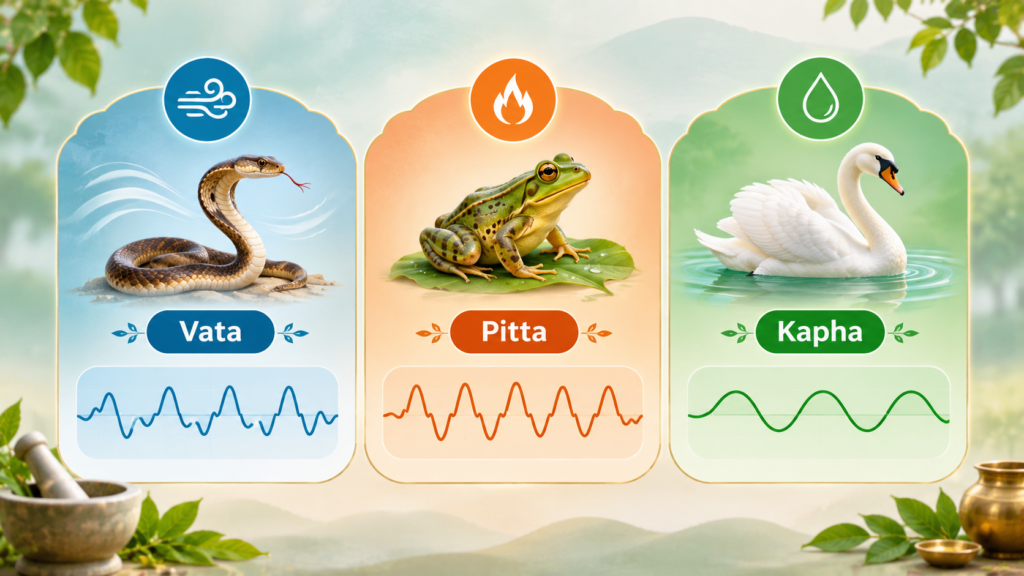
However, recognizing a mathematical pattern is not the same as establishing its clinical meaning. A pattern identified by an algorithm must be interpreted carefully, and its clinical relevance depends on the quality of the data, the model’s validation, and the context in which it is used.
D. Data Organization and Report Generation
Human sensation cannot easily recall exact numerical values of a pulse taken six months ago. AI excels at structuring data into long-term trends. It tracks how a patient’s pulse signature evolves over time, across seasons, or in response to specific treatment and lifestyle adjustments.
Digital systems can organize pulse recordings, patient details, and assessment results into structured reports.
Nadi Tarangini can help practitioners in following ways
- Maintain consistent digital records.
- Review pulse waveforms and related measurements.
- Compare observations across consultations.
- Communicate recorded findings more clearly.
- Support follow-up documentation and clinical research.
These functions can reduce the burden of manual documentation and help make clinical information easier to retrieve.
What Is AI-Based Pulse Analysis?
Traditional Nadi Pariksha involves more than collecting a physical signal. The Vaidya interprets the pulse within a broader clinical framework that includes individual constitution, current symptoms, history, examination findings, and the principles of Ayurveda.
AI-based pulse analysis refers to the use of computational techniques, and potentially machine learning, to examine pulse-related data and identify patterns within recorded signals.
In an Ayurvedic context, this technology aims to support the documentation and analysis of pulse characteristics while respecting the principles and clinical context of Nadi Pariksha.
The sensor captures the signal. Signal processing prepares it for analysis. Visualization makes recorded characteristics easier to inspect. Analytical algorithms may identify patterns, and reporting tools organize the results.
The Vaidya then considers these findings alongside the patient’s history, presenting complaints, examination, lifestyle, and other relevant clinical information.
It is important to distinguish digital pulse recording from AI-based interpretation. A device can capture and display a waveform without necessarily using AI. Similarly, automated calculations or predefined rules do not automatically constitute machine learning.
The specific capabilities of any system depend on its underlying technology.
Three distinctions are particularly important:
1. Measurement versus interpretation
A sensor records physical signals. Interpreting those signals in an Ayurvedic clinical context requires appropriate expertise and validated methods.
2. Pattern recognition versus diagnosis
An algorithm may identify similarities or differences between recordings. This does not, by itself, prove the presence of a disease, a Dosha imbalance, or a particular clinical condition.
3. Decision support versus autonomous decision-making
A digital report may support a practitioner’s assessment. Decisions about diagnosis, treatment, referral, and follow-up must remain grounded in professional judgment and appropriate clinical evaluation.
How Nadi Tarangini Connects Digital Technology With Ayurvedic Practice?
Nadi Tarangini brings digital pulse assessment into the contemporary Ayurvedic consultation environment by enabling pulse recording and digital visualization.
Such technology can help practitioners move beyond relying exclusively on handwritten notes when documenting pulse-related observations.
Its potential practical value lies in several areas.
Benefits of AI-Assisted Digital Pulse Assessment by Nadi Tarangini for Modern Clinics
When integrated thoughtfully, digital tools like Nadi Tarangini may offer practical advantages for Ayurvedic clinics and institutions.
Better documentation: Digital records can make it easier to maintain and retrieve pulse-related information. Digital recordings and visual representations can provide a more organized way to document pulse observations. This can be particularly useful when practitioners want to revisit previously recorded information.
More organized consultations: Structured reports can support the discussion of findings without requiring practitioners to reconstruct every previous observation from handwritten notes.
When comparable recordings are available across multiple visits, practitioners may review changes in recorded pulse characteristics over time.
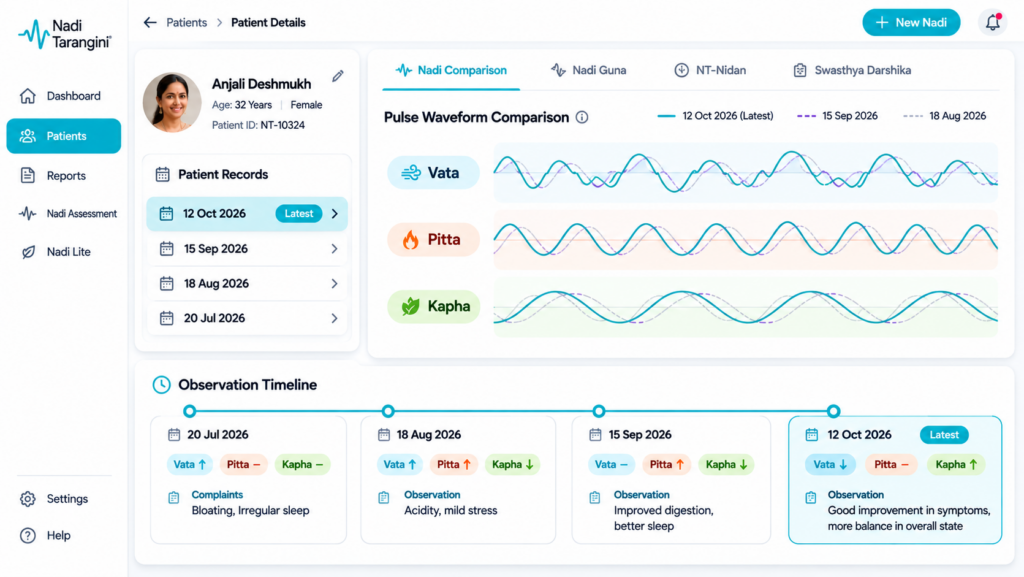
These observations can contribute to follow-up discussions, but a change in a waveform should not automatically be interpreted as evidence of clinical improvement or deterioration. It must be assessed alongside symptoms, examination findings, treatment history, and other relevant information.
Support for follow-up: Repeated recordings may help practitioners compare measurements over time, provided the recording conditions are sufficiently consistent.
Research opportunities: Organized datasets can support the investigation of pulse characteristics and their possible relationships with other clinical observations.
Workflow efficiency: Digital documentation may reduce some administrative tasks, allowing practitioners to devote more attention to patient interaction.
The extent of these benefits depends on the device, software, clinical workflow, training, and quality of implementation. They should be evaluated in practice rather than assumed.
The Future of Ayurveda: Intelligent Tools and Personalized Care
The future of AI in Ayurveda may include more sophisticated pulse-signal analysis, improved clinical documentation, longitudinal data visualization, and carefully validated decision-support tools.
As research progresses, digital systems may help investigators examine relationships between recorded pulse characteristics, Ayurvedic assessment frameworks, and other clinical measurements.
However, these possibilities require rigorous validation. AI-generated correlations should not be presented as established medical facts without supporting evidence.
The most useful direction is one in which technological innovation strengthens the practitioner’s ability to observe, document, investigate, and communicate without diminishing the importance of individualized clinical assessment.
For young Vaidyas, experienced practitioners, Ayurvedic colleges, and research institutions, digital tools like Nadi Tarangini may offer an opportunity to explore how classical concepts can be documented and studied using modern analytical methods.
The objective is not to make Ayurveda less individualized. It is to investigate whether better tools can help practitioners preserve and communicate that individuality more effectively.
AI as a Partner in the Evolution of Nadi Pariksha: Preserving Wisdom Through Precision
Artificial intelligence is creating new opportunities for digital pulse recording, signal processing, pattern analysis, and structured reporting in Ayurvedic practice.
Yet AI-assisted pulse analysis and autonomous diagnosis are not the same. A recorded waveform, a computational pattern, or an automated report cannot independently establish every clinical interpretation associated with Nadi Pariksha.
Nadi Tarangini represents an evolving intersection of Ayurvedic practice and modern technology. Their potential lies in supporting organized observation, clearer documentation, and further research while keeping the Vaidya at the centre of clinical decision-making.
AI can support the analysis of digital health measurements, pattern recognition, patient-record organization, clinical documentation, and decision-support workflows. In digital Nadi assessment, computational tools may help process pulse signals, examine waveform features, and generate structured reports. Their clinical value depends on validation and practitioner interpretation.
AI-Assisted Analysis vs. Autonomous Diagnosis: Why the Vaidya Remains Essential
One of the most important principles in AI-assisted healthcare is understanding the limits of automation.
A computational system may process large volumes of data quickly, but clinical interpretation requires more than computational speed.
An Ayurvedic practitioner considers the individual as a whole, including:
- Prakriti, or constitutional characteristics.
- Vikriti, or the current state of imbalance within the Ayurvedic framework.
- Presenting symptoms and their duration.
- Dietary habits, sleep, stress, and lifestyle.
- Clinical history and relevant examination findings.
- Response to previous interventions and the need for further evaluation.
These factors cannot simply be replaced by a single waveform or automated report.
AI should therefore be approached as an aid to observation and analysis, not as an unquestionable authority.
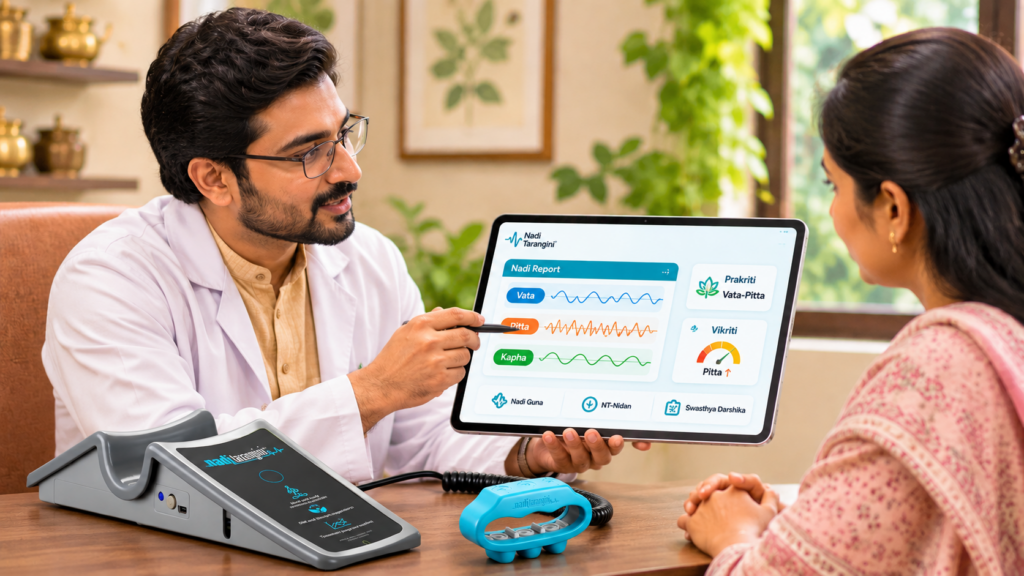
As modern technology converges with ancient medicine, digital Nadi Pariksha systems such as Nadi Tarangini are transforming pulse assessment into precise, reproducible data. However, integrating artificial intelligence (AI) into clinical practice requires a clear distinction: AI serves as an intelligent decision-support tool, not an autonomous diagnostic engine.
In Ayurvedic medicine, a pulse waveform is only one piece of a complex diagnostic ecosystem. An AI algorithm can process tactile waveforms with high precision, but it lacks the qualitative insight and holistic clinical context required for genuine healing.
AI technology provides high-resolution data, but the Vaidya provides clinical understanding. The future of modern Ayurvedic diagnostics lies in human-in-the-loop healthcare: leveraging digital pulse analytics to empower practitioners, while keeping clinical decision-making firmly in human hands.
Nadi Tarangini supports digital pulse assessment through pulse recording and visualization. Depending on the features available in a particular system, digital tools can help organize and review pulse-related information. The clinical meaning of recorded findings must be assessed within the broader consultation.
The future of Ayurveda is not a choice between ancient wisdom and artificial intelligence. It is an opportunity to explore how technology can responsibly support clinical expertise, personalized care, and evidence-informed innovation.
Conclusion: Bringing AI and Traditional Nadi Pariksha Together
The integration of AI in Ayurveda represents an evolving opportunity to connect traditional Ayurvedic knowledge with modern technological advancements. Through AI-based pulse analysis, digital Nadi Pariksha systems, and structured data analysis, practitioners can explore new ways to document pulse characteristics, review recorded observations, and maintain organized patient records.
However, technology should complement rather than replace the knowledge and clinical judgment of an experienced Vaidya. The interpretation of pulse characteristics must always consider Prakriti, Vikriti, symptoms, lifestyle, and the individual’s overall health.
Nadi Tarangini represents this integration of traditional Ayurvedic practice with digital pulse assessment. By supporting pulse recording, waveform visualization, and structured reporting, it helps practitioners bring greater organization and clarity to their clinical documentation.
The future of AI-assisted pulse analysis in Ayurveda lies in responsible technological innovation, continued research, and practitioner-led clinical assessment. By bringing together traditional wisdom and modern analytical tools, Ayurveda can continue exploring new possibilities for personalized care while keeping the Vaidya at the centre of every clinical decision.