
Why Ayurveda Colleges Are Showing Interest in Nadi Tarangini-Based Learning

Why Ayurveda Colleges Are Showing Interest in Nadi Tarangini-Based Learning
 Dr. Gayatri Mulye
Ayurveda has always emphasized learning through observation, practice, and continuous clinical exposure. The concept and method of Nidana (Diagnosis) in Ayurveda mainly depends on the understanding of Dosha and prakriti – Vikruti.
Ashtavidha Pariksha (eightfold examination) is the main diagnostic system mentioned in Ayurveda from which Nadi Pariksha holds a central place in Ayurveda.
Nadi Pariksha is one of the most sophisticated non-invasive diagnostic tools in traditional medicine revealing constitutional type, dosha imbalances, tissue health, digestive strength, and organ status through pulse reading.
The Pulse as a Mirror of the Dosha
The fundamental framework of Ayurvedic medicine rests upon the understanding of the three doshas: vata, pitta, and kapha. These three biological energetics govern all psycho-physiological functions-from movement and metabolism to structure and immunity. The pulse serves as a dynamic meter reflecting the balance or current disturbance, called vikruti, of these three energies.
Traditional learning depends heavily on repeated clinical exposure and mentorship. Since pulse perception is subjective, beginners often struggle to understand what they are expected to feel. The same patient may be interpreted differently by different learners until sufficient experience is gained.
The Challenge of Learning Nadi Pariksha
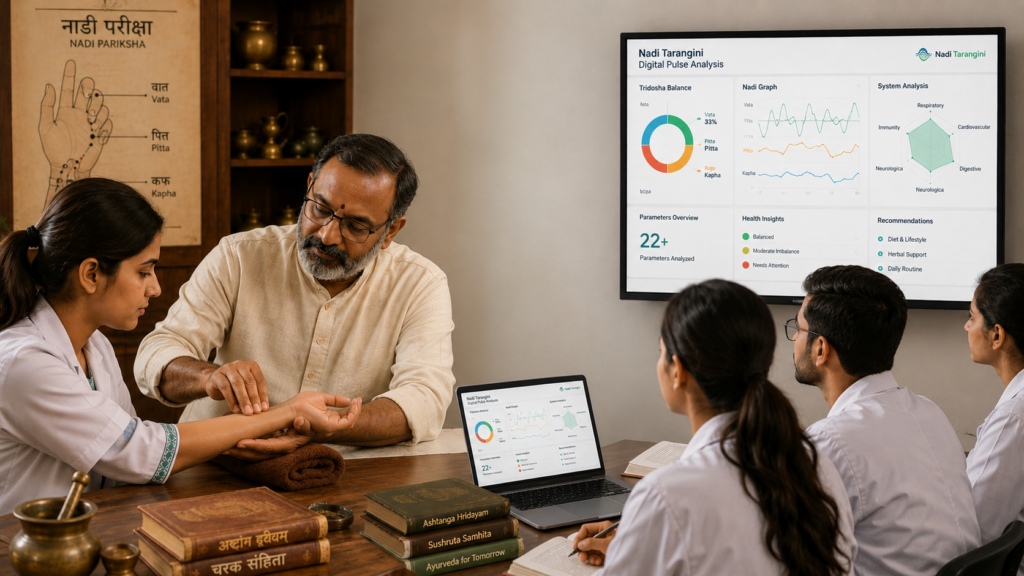
Every Ayurvedic student studies the principles of Tridosha, Prakriti, Vikruti, Agni, Dhatu, and other fundamental concepts. However, translating this theoretical knowledge into accurate pulse interpretation is not always straightforward.
For many students, understanding subtle pulse qualities and correlating them with classical Ayurvedic concepts can be one of the most challenging aspects of their education.
Ayurvedic institutions increasingly embrace digital learning tools, technologies such as Nadi Tarangini are gaining attention for their potential to complement traditional teaching methods.
Rather than replacing classical pulse examination, these technologies provide an additional layer of visualization and documentation that can make learning more structured, repeatable, and research-friendly.
Nadi Tarangini helps institutions and colleges in following ways –
Bridging Theory with Clinical Observation
Ayurvedic education is most effective when theoretical knowledge is reinforced through real patient interactions.
Digital pulse analysis by Nadi Tarangini helps students connect concepts such as Dosha balance, Prakriti, Vikruti, and physiological changes with documented pulse observations. As they study a wider range of cases, they gain a deeper understanding of how classical principles are reflected in clinical practice, making the transition from classroom learning to patient care more meaningful.
Ayurveda teaches that every patient is unique. Understanding that individuality requires repeated observation across many cases.
Nadi Tarangini enables students to correlate pulse findings with:
- Prakriti assessment
- Vikruti assessment
- Dosha predominance
- Seasonal influences
- Lifestyle factors
- Clinical symptoms
As students encounter more documented cases, they begin recognizing clinical patterns more systematically, making classroom concepts easier to apply in real-world practice.
Making Pulse Patterns Visible
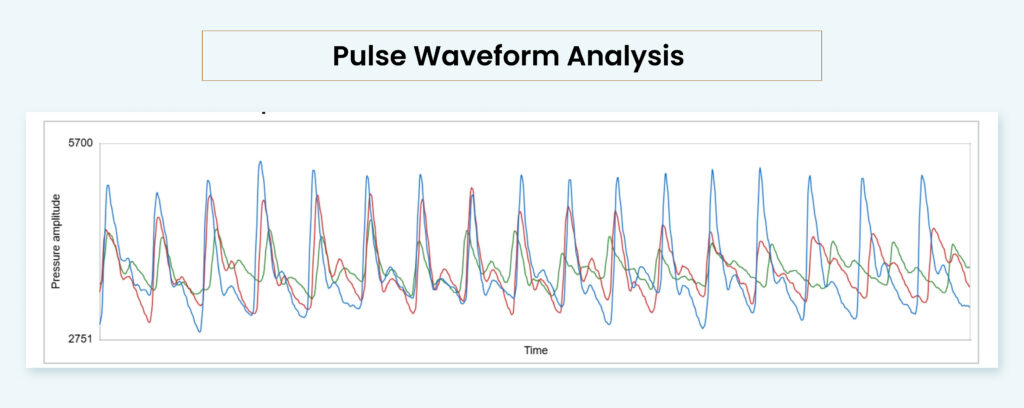
One of the biggest advantages of Nadi Tarangini is its ability to digitally capture pulse waveforms and present them in a visual format.
Instead of relying only on tactile sensation, students can observe:
- Digital pulse waveforms
- Pulse rhythm and characteristics
- Tridosha-related observations
- Comparative pulse recordings
- Changes across multiple follow-up visits
Visual representation helps learners associate what they read in Ayurvedic texts with measurable pulse patterns observed during clinical practice. This creates a stronger connection between theory and hands-on learning.
Supporting Research-Oriented Education
One of the growing priorities for Ayurvedic colleges is strengthening research and evidence generation. High-quality research depends on consistent documentation and longitudinal clinical data.
Nadi Tarangini contributes by enabling standardized pulse recording that can be revisited and analysed over time.
For research scholars, this offers opportunities to:
- Build structured clinical datasets.
- Compare pulse observations across patient groups.
- Monitor changes during treatment.
- Study long-term wellness trends.
- Generate repeatable observations for academic studies.
Support institutional research projects with documented digital records.
Instead of relying solely on handwritten notes, researchers gain access to organized digital information that is easier to review, compare, and analyse.
Reducing Ambiguity During Early Clinical Training
Pulse examination is a skill that develops with experience, and beginners often struggle with confidence when learning to identify different pulse characteristics. Since pulse assessment depends on careful observation and interpretation, repeated practice is essential.
By providing standardized pulse recordings and visual representations, Nadi Tarangini offers students an additional reference during their learning journey. They can revisit recorded cases, compare pulse observations across different patients, and participate in guided discussions with faculty.
This structured approach reduces uncertainty during early training while encouraging students to develop their own clinical reasoning based on Ayurvedic principles.
Creating Better Clinical Documentation
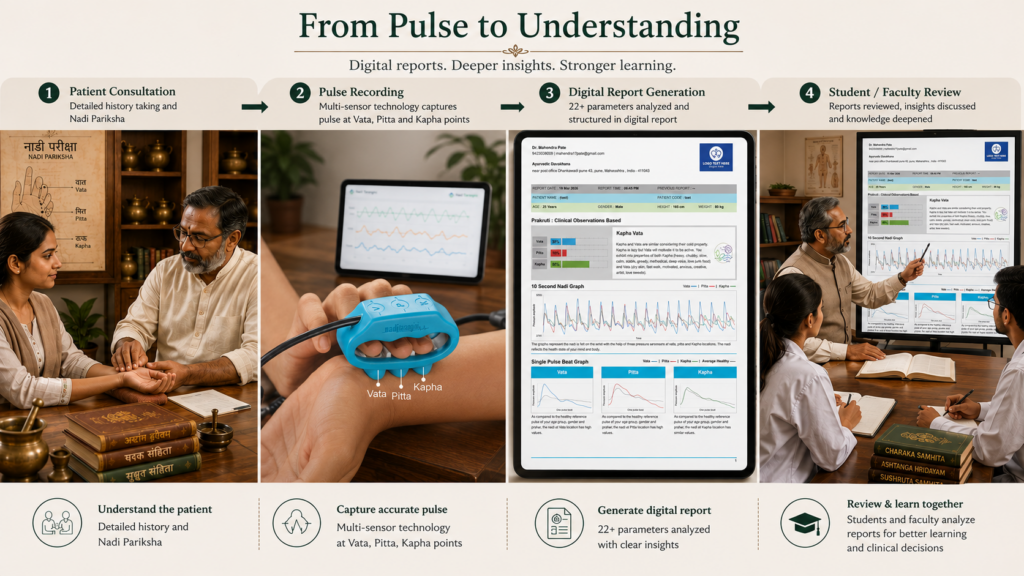
Modern education increasingly values documentation, case presentations, and outcome tracking.
Digital pulse reports generated through Nadi Tarangini allow students to maintain organized clinical records that include pulse observations alongside other patient information. These reports can support classroom discussions, internships, dissertations, and clinical audits while promoting a more systematic approach to case documentation.
Understanding Nadi Tarangini Map
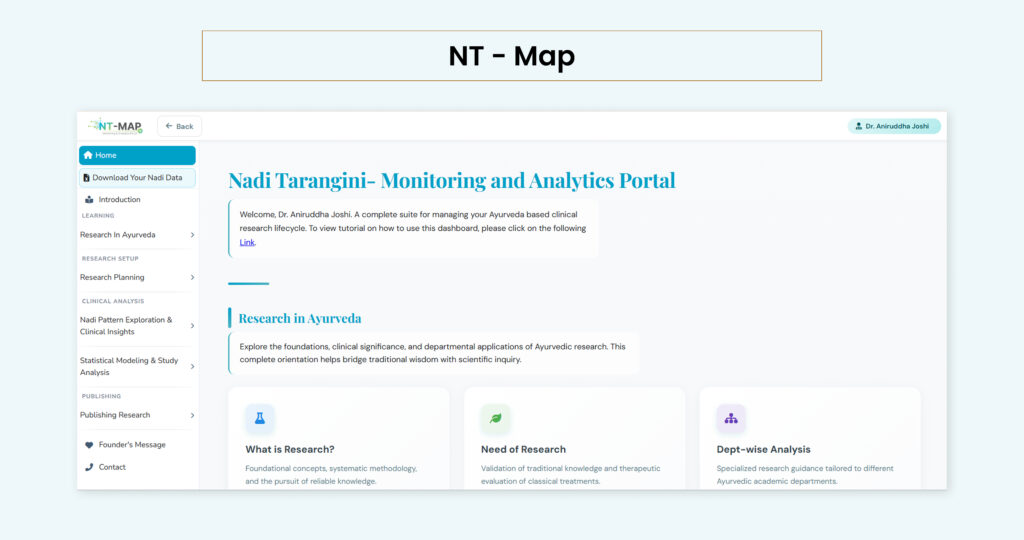
NT-Map is a visual representation of pulse-derived observations that helps organize information in an intuitive format. Rather than viewing pulse data as isolated measurements, students and researchers can examine relationships among multiple Ayurvedic wellness parameters through a single visual interface.
For students, NT-Map can:
- Simplify interpretation of complex pulse information.
- Help correlate pulse observations with classical Ayurvedic concepts.
- Make case discussions more interactive.
- Improve understanding of patient-specific patterns.
- Enhance learning during demonstrations and practical sessions.
For faculty members and researchers, NT-Map provides an efficient way to compare cases, discuss findings, and identify trends across larger patient populations.
By presenting information visually, NT-Map encourages analytical thinking while remaining rooted in Ayurvedic principles.
Complementing Traditional Ayurvedic Learning
It is important to recognize that technologies like Nadi Tarangini are designed to complement not replace the expertise of Ayurvedic physicians.
The interpretation of pulse findings continues to depend on classical Ayurvedic knowledge, clinical reasoning, and the practitioner’s judgment. Digital tools simply provide additional information that can enhance observation, improve documentation, and support education and research.
The Future of Ayurvedic Education
As Ayurvedic education evolves, institutions are seeking ways to combine the wisdom of classical texts with modern methods of teaching and documentation. Technology-assisted pulse analysis offers an opportunity to make learning more interactive, consistent, and research-oriented without compromising traditional principles.
By helping students visualize pulse patterns, build structured clinical records, explore tools like NT-Map, and participate in data-driven research, Nadi Tarangini is contributing to a more comprehensive educational experience. As more colleges focus on evidence generation and clinical excellence, such technologies may play an increasingly valuable role in preparing the next generation of Ayurvedic practitioners.
Summary
Nadi Tarangini can support Ayurvedic education by helping colleges bridge the gap between classical theory and practical clinical observation. By digitally capturing and visualizing pulse patterns, it gives students an additional reference for understanding concepts such as Prakriti, Vikruti, Dosha balance, and clinical changes.
For research and academic institutions, Nadi Tarangini can support structured clinical datasets, longitudinal records, treatment monitoring, case comparisons, and research documentation. NT-Map further helps present pulse-derived observations visually, making complex information easier to interpret and discuss.
Overall, Nadi Tarangini is positioned as a complement to traditional Ayurvedic learning. By combining classical knowledge with visualization, documentation, and data-supported learning, it can help make Ayurvedic education more practical, structured, interactive, and research-oriented.