
How Nadi Tarangini Is Making Ayurveda More Research-Oriented

How Nadi Tarangini Is Making Ayurveda More Research-Oriented
 Dr. Gayatri Mulye
Accurate diagnosis is the foundation of effective Ayurvedic treatment. Unlike symptom-centric systems of medicine, Ayurveda relies on deep clinical observation, individualized assessment, and root-cause analysis. As Ayurvedic practice scales across clinics and institutions, ensuring diagnostic consistency and documentation becomes increasingly challenging.
For centuries, Ayurveda has relied on careful clinical observation, individualized assessment like Nadi Pariksha, and the expertise of practitioners to understand a patient’s health. While these principles remain the foundation of Ayurvedic practice, there is an increasing need to document observations in a structured, measurable, and repeatable manner. As healthcare moves toward evidence-based practice, digital technologies are helping Ayurveda generate meaningful clinical data without compromising its traditional principles.
One such advancement is Nadi Tarangini, a digital pulse-analysis system that captures pulse signals and presents them in a standardized digital format. Rather than replacing the physician’s clinical judgment, it provides a systematic method of recording pulse observations, making them easier to compare, review, and study over time.
Why Structured Clinical Data Matters?
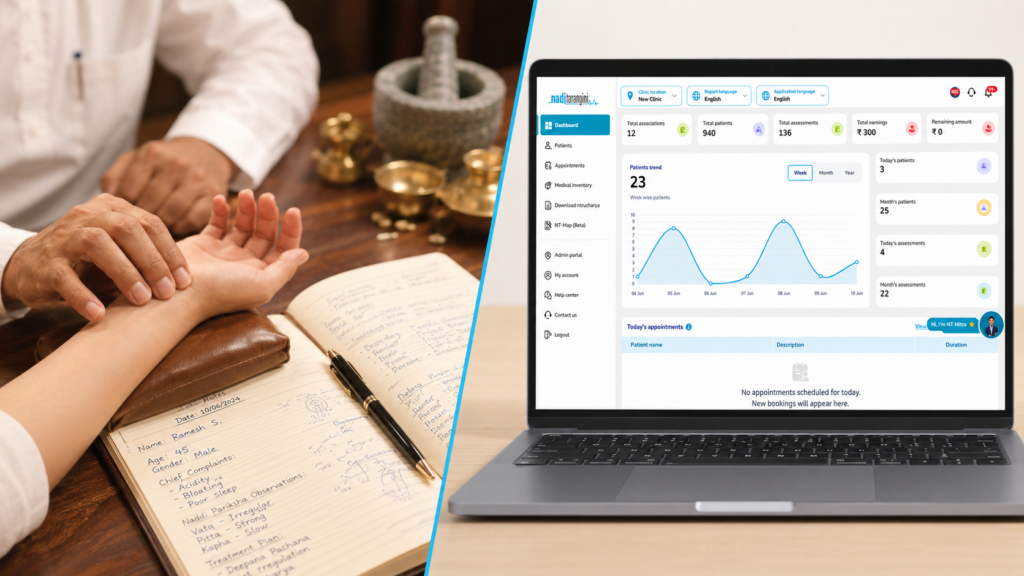
Traditional Nadi Pariksha relies heavily on individual practitioner experience, leading to variable interpretations.
Traditionally, pulse examination findings were recorded in handwritten notes, making it difficult to compare observations across multiple visits or between different practitioners.
Digital pulse-analysis systems address this challenge by creating structured records that can be stored, retrieved, and analyzed. Standardized digital documentation helps practitioners maintain consistency while supporting long-term clinical studies and institutional research.
Following are the some benefits-
•Standardization– Converts qualitative Nadi Pariksha notes into graphic readable metrics.
•Evidence Generation– Builds large datasets to support clinical research.
•Interoperability– Aligns ancient diagnostic markers with modern health formats.
Longitudinal Patient Record For Better Clinical Insights
Ayurvedic treatment often focuses on gradual improvement through personalized therapies and lifestyle modifications. Monitoring these changes requires reliable follow-up records.
By digitally recording pulse assessments during each consultation, practitioners can build longitudinal patient datasets. These records allow them to:
• Compare pulse observations across multiple visits.
• Observe changes during different treatment phases.
• Monitor seasonal variations in wellness.
• Review patient progress over months or even years.
Such long-term documentation supports more informed clinical decision-making and contributes valuable information for future research.
Building Evidence for Ayurvedic Research
There is growing interest in generating high-quality evidence to support Ayurvedic practice. While digital tools alone do not validate clinical outcomes, they provide an important foundation by improving the quality, organization, and accessibility of clinical data.
Nadi Tarangini enables practitioners to preserve detailed clinical observations while creating structured records suitable for education, research, and long-term patient monitoring.
Structured datasets created by Nadi Tarangini makes it easier to conduct observational studies, compare findings across patient groups, and document clinical experiences systematically. Over time, this approach can contribute to stronger evidence-building initiatives and encourage greater integration of research into everyday Ayurvedic practice.
When digital records generated by Nadi Tarangini are collected consistently, they can reveal valuable clinical patterns that may otherwise go unnoticed.
Nadi Tarangini serves as a valuable research tool by enabling standardized pulse recording, longitudinal data collection, and objective analysis. It supports evidence generation in Ayurveda by following ways.
Making Pulse Observations More Repeatable
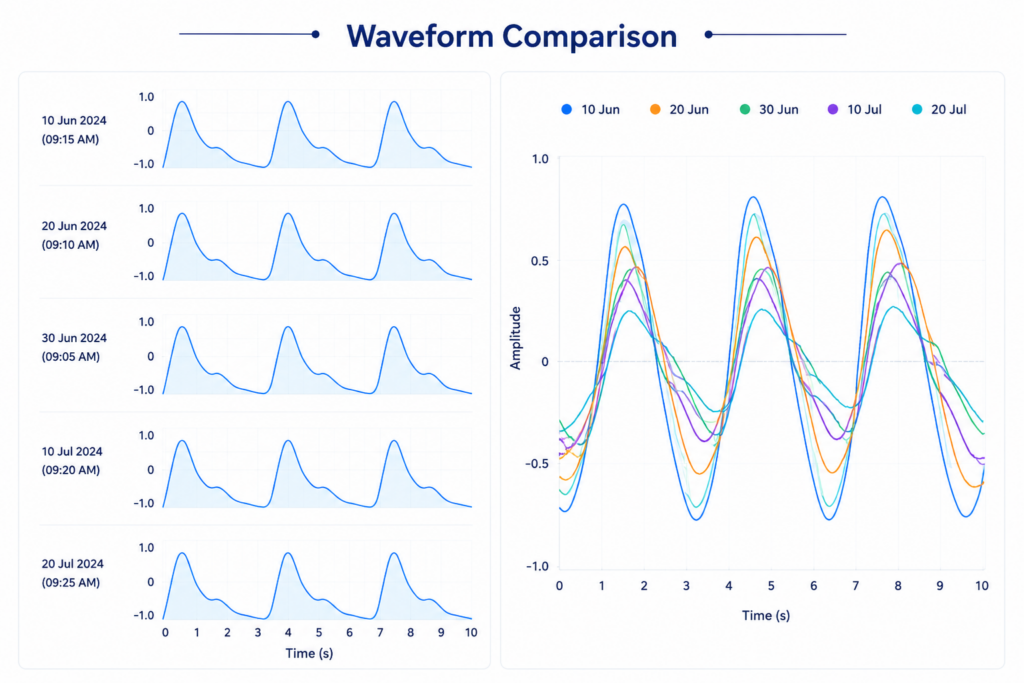
Repeatability is an important aspect of scientific investigation. Although pulse interpretation continues to depend on the physician’s expertise, digitally captured pulse signals provide a consistent record that can be reviewed whenever needed.
Having standardized pulse waveforms enables practitioners and researchers to revisit previous observations, compare different patient cases, and evaluate patterns with greater consistency than handwritten descriptions alone
Identifying Wellness Trends
Researchers and practitioners may study trends by using reports generated by Nadi Tarangini such as:
• Common Dosha imbalances in different age groups.
• Seasonal variations in pulse characteristics.
• Wellness changes during preventive care programs.
• Patterns observed before and after Ayurvedic interventions.
These observations can generate research questions and contribute to a better understanding of population wellness within an Ayurvedic framework.
Turning Complexity into Clarity
One of the biggest challenges in Ayurvedic research has been the availability of consistent and structured clinical data. Since Ayurvedic treatments are highly individualized, documenting a patient’s health journey over time is essential for understanding how wellness changes with personalized interventions. This is where longitudinal datasets become valuable.
Nadi Tarangini can help researchers by recording pulse assessments digitally during every consultation, Nadi Tarangini enables practitioners to build a chronological record of observations.
Instead of relying solely on handwritten notes or memory, doctors can compare pulse records from different visits, identify trends, and monitor changes in a patient’s condition over weeks, months, or even years. Such longitudinal data supports follow-up care while also creating valuable datasets for clinical research.
Another important aspect is the generation of measurable observations. Nadi Tarangini captures pulse waveforms and physiological signals in a standardized format, allowing observations to be documented consistently.
While interpretation continues to depend on the clinical expertise of the Ayurvedic physician, standardized digital records of Nadi Tarangini make it easier to review findings, compare cases, and maintain uniform documentation across consultations.
Empowering Institutional Research with Nadi Tarangini
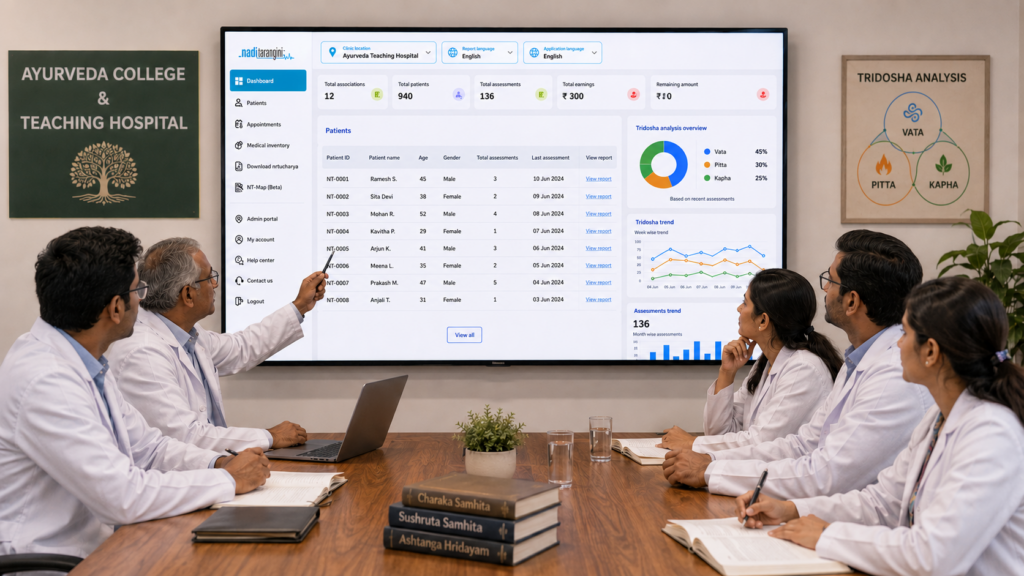
Ayurvedic colleges, teaching hospitals, and research institutions require organized clinical datasets for academic projects and observational studies.
Digital pulse-analysis by Nadi Tarangini simplifies this process by enabling institutions to collect structured wellness data from large numbers of patients.
Researchers can then examine trends related to Prakriti, Vikriti, seasonal influences, and treatment responses across broader patient populations. Such organized data can strengthen academic research while encouraging collaboration among clinicians and institutions.
The Future of Ayurvedic Research
The future of Ayurveda lies in combining traditional wisdom with modern methods of documentation and analysis.
As more clinics and institutions adopt digital documentation, Ayurveda will have greater opportunities to develop robust clinical datasets, support collaborative research, and strengthen the scientific understanding of its time-tested principles—while always recognizing that digital pulse analysis is intended to complement, not replace, the clinical expertise and holistic assessment of qualified Ayurvedic practitioners.
Repeatable digital Nadi Pariksha reports strengthen research efforts. When pulse signals are recorded using the same methodology at different time points, researchers can compare observations more objectively and study patterns across larger patient populations. This consistency is particularly useful for observational studies, institutional research projects, and multi-centre collaborations, where standardized documentation improves the quality and comparability of collected data.
As more Ayurvedic clinics, teaching hospitals, and research institutions adopt digital documentation, these structured datasets can contribute to evidence-building initiatives. They can help researchers identify wellness trends, study seasonal variations, evaluate treatment responses, and generate clinical insights that support future scientific investigations. Although digital pulse analysis does not replace the physician’s judgment or by itself establish clinical effectiveness, it provides a stronger foundation for systematic documentation and research in modern Ayurveda.
Summary
As digital documentation becomes more widely adopted, Nadi Tarangini is helping make Ayurveda more research-oriented by improving the quality, consistency, and accessibility of clinical data while preserving the traditional principles and holistic approach of Ayurvedic practice.
By creating structured digital records, Nadi Tarangini enables consistent documentation, longitudinal patient tracking, and easier comparison of pulse observations over time. These records support follow-up care, help identify wellness trends, and provide valuable datasets for observational studies and institutional research.
The system also facilitates standardized pulse recording, making it possible to analyze patterns related to Dosha imbalances, seasonal variations, and treatment responses across larger patient populations. This organized approach strengthens academic research, promotes collaboration among Ayurvedic institutions, and contributes to evidence-building initiatives.