
From Pulse Patterns to Dosha Insights Using Nadi Tarangini: A Modern Ayurvedic Approach
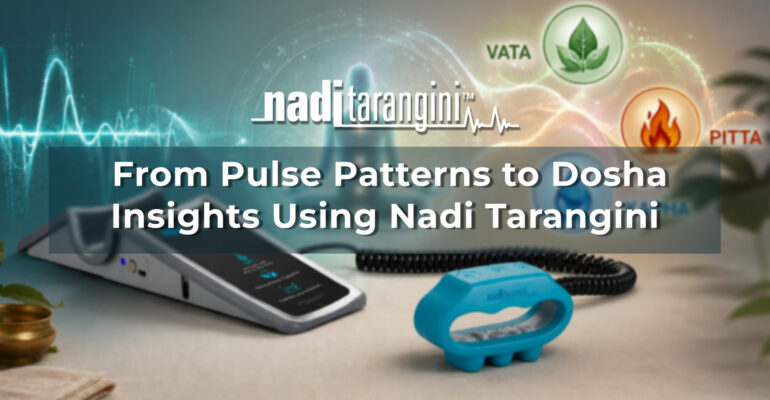
From Pulse Patterns to Dosha Insights Using Nadi Tarangini: A Modern Ayurvedic Approach
 Dr. Gayatri Mulye
Ayurveda has recognized that every individual possesses a unique constitutional makeup known as Prakriti, determined by the balance of the three Doshas—Vata, Pitta, and Kapha. Understanding these Doshas forms the foundation of Ayurvedic diagnosis, prevention, and personalized healthcare.
Nadi Pariksha (pulse examination) is one of the most refined diagnostic tools in Ayurveda, traditionally used to assess the balance of Vata, Pitta, and Kapha doshas through subtle pulse sensations. However, classical Nadi Pariksha relies heavily on practitioner sensitivity and experience, making consistency and reproducibility a challenge.
Nadi Tarangini introduces a modern, structured approach to capturing pulse waveforms, enabling Ayurvedic practitioners to observe, record, and analyze pulse patterns in a more objective and repeatable manner.
The Traditional Understanding of Doshas

For centuries, Ayurvedic practitioners have assessed Dosha predominance through a combination of:
- Pulse examination (Nadi Pariksha)
- Observation of body structure and complexion
- Evaluation of digestion, sleep and energy patterns
- Emotional and behavioral tendencies
- Disease history and lifestyle habits
As Ayurveda expands globally, there is growing interest in creating methods that can support traditional wisdom with measurable observations.
Modern healthcare increasingly emphasizes objective assessment, reproducibility, and data-driven decision-making. Patients often seek clear explanations and measurable indicators of their health status. This has encouraged researchers and Ayurvedic innovators to explore ways of translating traditional pulse assessment into quantifiable patterns without compromising Ayurvedic principles.
The goal is not to replace the practitioner but to provide additional insights that enhance accuracy, documentation, and long-term monitoring.
Pulse as a Window Into Assessment of Ayurvedic parameters
According to Ayurveda, the Nadi i.e. pulse reflects the dynamic state of Doshic activity within the body. Subtle variations in rhythm, force, tension, and movement are believed to indicate the influence of Vata, Pitta, and Kapha.
During the examination, an Ayurvedic practitioner lightly places three fingers—index, middle, and ring—on the patient’s wrist. Each finger corresponds directly to a specific dosha.

Index Finger (Vata) senses the pulse near the base of the thumb. Vata movement is often described as resembling the movement of a snake (irregular and darting).
Middle Finger (Pitta) senses the pulse in the middle position. Pitta movement feels like a jumping frog or a leaping serpent (bounding and active).
Ring Finger (Kapha) senses the pulse at the third position. Kapha movement resembles the swimming of a swan or an ocean wave (steady, slow, and heavy).
Modern pulse-analysis technologies used by Nadi Tarangini aim to capture these subtle pulse characteristics using sensors and signal-processing techniques. Instead of relying solely on subjective sensation, pulse waveforms can be recorded, analyzed, and interpreted through standardized parameters.
Nadi Tarangini creates an opportunity to observe physiological trends in a more structured manner while preserving the Ayurvedic framework of Dosha assessment.
Nadi Tarangini helps practitioners visualize pulse characteristics that may otherwise be difficult to quantify by following ways.
- Record pulse signals consistently
- Analyze pulse-wave patterns
- Generate structured reports
- Support Dosha-related observations
- Track changes over time
- Improve documentation and patient communication
Such approaches provide an additional layer of information that can complement traditional clinical judgment. Standardized pulse recording can reduce variations in assessment and provide more consistent observations across consultations.
Visual reports and measurable indicators help patients better understand their constitutional tendencies and current imbalances. Also, changes in Dosha-related patterns can be tracked over time, supporting preventive healthcare and lifestyle modifications.
By bridging classical Ayurvedic wisdom with modern analytical methods, pulse-based diagnostics may help Ayurveda become more accessible, consistent, and integrative in contemporary healthcare.
From Pulse Patterns to Dosha Insights: Understanding How Nadi Pariksha Maps Dosha Imbalances
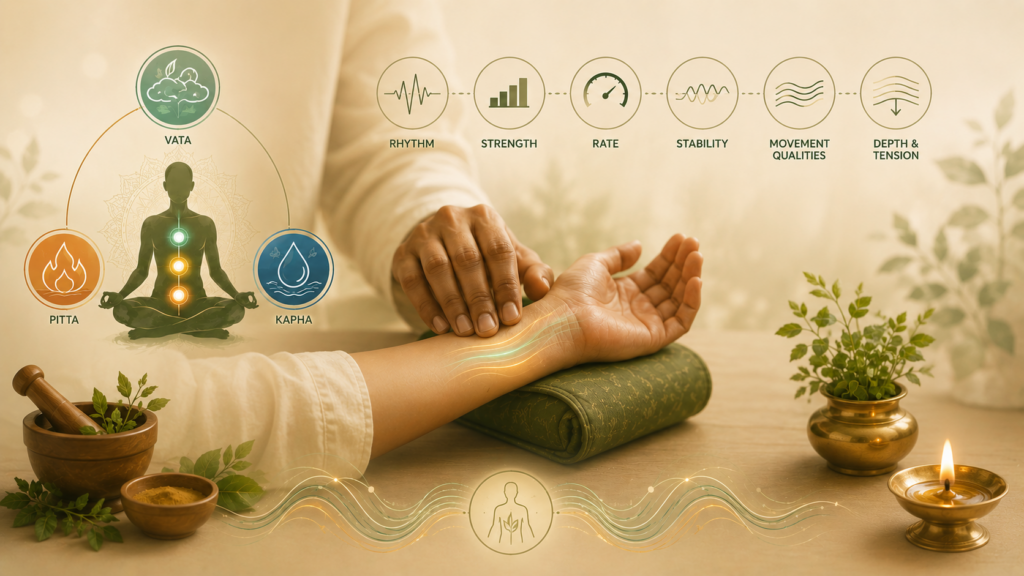
Nadi Pariksha offers a unique window into the body’s internal state. Through careful observation of pulse characteristics, practitioners can gain insights into Dosha predominance, emerging imbalances, and overall physiological functioning. Today, advancements in pulse assessment technologies are helping bring greater structure and consistency to this ancient practice, allowing practitioners to complement traditional wisdom with objective observations.
According to Ayurveda, the pulse reflects the ongoing interaction of the Doshas within the body. Every individual possesses a unique constitutional balance (Prakriti), while daily habits, diet, emotions, environment, and lifestyle factors can create temporary or long-term imbalances (Vikriti).
Nadi Pariksha seeks to identify these patterns by evaluating various pulse characteristics, including:
- Rhythm
- Strength
- Rate
- Stability
- Movement qualities
- Depth and tension
These qualities are interpreted collectively rather than in isolation, providing a holistic understanding of the individual’s current state.
The true value of Nadi Pariksha lies not merely in identifying which Dosha is present, but in understanding the complex interplay among all three Doshas.
In traditional Nadi Pariksha, practitioners rely on tactile perception—speed, rhythm, depth, and force of the pulse. Pulse assessment relied heavily on practitioner experience and subjective interpretation.
Modern pulse-analysis technologies are introducing new possibilities for consistency and documentation. One of the most significant contributions of Nadi Tarangini is its ability to assist in correlating pulse characteristics with doshic states in following ways.
- By converting subtle Pulse Sensations into Structured Data
- Recording pulse wave characteristics over time
- Identifying rhythmic variability and amplitude shifts
- Highlighting recurring waveform signatures
- Reducing dependence on purely subjective interpretation
This allows pulse observation to shift from “felt intuition” toward repeatable pattern recognition.
At its core, the system aims to translate subtle pulse qualities into consistent diagnostic patterns associated with Vata, Pitta, and Kapha dynamics, improving reproducibility and clinical clarity. Traditional interpretation often ends at broad categorization (Vata/Pitta/Kapha dominance) generally. Nadi Tarangini enhances this by enabling:
- Mixed Dosha profiling (e.g., Vata-Pitta – kapha in percentage)
- Detection of subtle imbalance transitions before symptoms appear
- Monitoring pulse changes according to treatment
- Identifying dynamic shifts rather than static constitution
This is crucial because most clinical presentations are not single-Dosha but multi-layered imbalances evolving over time.
This report generated by Nadi Tarangini supports practitioners in decision-making by strengthening correlation between pulse and symptom clusters and improving longitudinal tracking of patient recovery.
Pulse-based analytical approaches represent an important step toward bridging ancient knowledge and modern technology. By transforming subtle pulse observations into structured data, Ayurveda can become more accessible, measurable, and understandable while remaining true to its foundational principles.
The future of Ayurveda lies not in replacing traditional wisdom but in strengthening it through responsible innovation.
Nadi Pariksha remains one of Ayurveda’s most sophisticated methods for understanding human health. By interpreting pulse patterns and relating them to Dosha dynamics, practitioners can gain valuable insights into an individual’s current state of balance and potential areas of concern.
The combination of traditional Ayurvedic knowledge and contemporary pulse-analysis technologies by Nadi Tarangini offers exciting opportunities for deeper understanding, early awareness of imbalance, and truly personalized wellness care.
The pulse is more than a heartbeat—it is a reflection of the body’s ongoing dialogue between balance and imbalance, offering a pathway toward greater self-awareness and preventive healthcare.
Nadi Tarangini represents a meaningful evolution in Ayurvedic diagnostics by transforming the subtle art of pulse reading into a structured, analyzable system. By mapping pulse wave patterns to Vata, Pitta, and Kapha imbalances, it enhances clarity, consistency, and clinical confidence while remaining rooted in the foundational principles of Ayurveda.
Summary
A Modern Ayurvedic Approach explores how traditional Ayurvedic pulse diagnosis (Nadi Pariksha) is evolving through modern pulse-analysis technology. Ayurveda recognizes health through the balance of the three Doshas—Vata, Pitta, and Kapha—and Nadi Pariksha has long been a sophisticated method for assessing these energies through pulse examination.
Traditionally, pulse assessment depended heavily on the practitioner’s experience and tactile sensitivity, which could lead to variations in interpretation. Nadi Tarangini introduces a structured and objective approach by digitally capturing pulse waveforms and analyzing subtle pulse characteristics such as rhythm, strength, stability, tension, and movement patterns.
By converting pulse signals into measurable data, Nadi Tarangini helps practitioners visualize Dosha-related patterns, generate detailed reports, monitor changes over time, and improve patient communication.
The technology supports identification of constitutional tendencies (Prakriti), current imbalances (Vikriti), mixed Dosha profiles, and subtle shifts that may occur before symptoms become apparent.
Rather than replacing traditional Ayurvedic wisdom, Nadi Tarangini enhances Nadi Pariksha by improving consistency, documentation, and reproducibility. This integration of ancient knowledge with modern analytical methods offers a promising pathway toward more personalized, preventive, and evidence-informed Ayurvedic healthcare.
Ultimately, the article highlights how pulse-based analytics can strengthen clinical decision-making while preserving the core principles of Ayurveda, making pulse assessment more accessible, structured, and meaningful in contemporary wellness practice.