
The Future of Ayurvedic Diagnostics: AI, Pulse Analytics, and Personalized Healthcare
The Future of Ayurvedic Diagnostics: AI, Pulse Analytics, and Personalized Healthcare
 Dr. Gayatri Mulye
Ayurveda has always emphasized understanding the individual rather than treating every patient through a standardized approach. From assessing Prakruti and Vikruti to understanding Dosha imbalances, Ayurvedic healthcare is rooted in personalized observation, clinical reasoning, and a holistic understanding of health.
One of the traditional assessment methods associated with this approach is Nadi Pariksha (Ayurvedic pulse diagnosis). For generations, Ayurvedic practitioners have relied on their clinical knowledge and experience to assess the pulse alongside other examination methods and patient history.
Today, healthcare is entering a new era driven by artificial intelligence (AI) in Ayurveda, sensor technology, digital pulse analytics, and healthcare data analytics. These developments are creating opportunities to explore how traditional Ayurvedic knowledge can be supported by AI-powered Ayurvedic diagnostics, digital Nadi Pariksha, and modern healthcare technology to advance personalized healthcare.
This evolution raises an important question,
Can technology make Ayurvedic diagnostics more structured, consistent, and scalable without compromising the fundamental principles of Ayurveda?
Nadi Tarangini represents one approach to this evolving landscape. By combining sensor-based pulse recording, digital pulse analytics, and structured reporting, it seeks to support practitioners in integrating technology into their clinical workflows.
The future of Ayurvedic diagnostics may not depend on choosing between tradition and technology, but on understanding how innovation can support the expertise of the Ayurvedic practitioner.
Ayurvedic Diagnostics Are Entering a Digital Era
Patients today increasingly seek healthcare experiences that offer personalized consultations, clear communication, organized records, and continuity of care. At the same time, Ayurvedic clinics are managing growing patient volumes, follow-up requirements, and, in some cases, multiple practitioners working together.
These changes create practical challenges in clinical documentation and information management. Traditional clinical knowledge remains essential, but digital tools can help practitioners organize and access information more efficiently.
Nadi Pariksha has an established place in traditional Ayurvedic practice. It involves pulse examination as part of the practitioner’s broader clinical assessment.
Traditionally, pulse assessment depends significantly on the practitioner’s training, experience, and ability to integrate observations with the patient’s presentation.
Digital pulse analytics by Nadi Tarangini can introduce another dimension. A sensor-based pulse analysis system generally involves several stages, beginning with signal capture, where sensors record pulse-related physiological signals. The captured data then undergoes signal processing, converting the raw signals into structured digital information that can be further analyzed. The processed pulse data may then be presented through visualizations such as waveforms, graphs, or other graphical formats, making pulse patterns easier to observe and interpret.
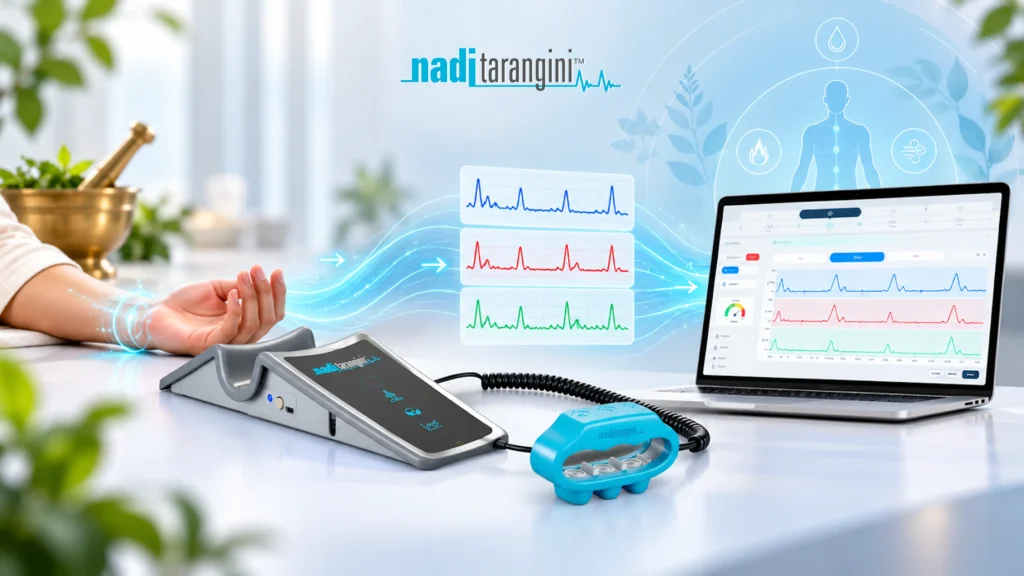
Finally, intelligent analysis uses software-based analytical methodologies to process the recorded information and generate structured insights from the captured pulse signals.
Instead of relying only on manually observed information, digital systems can capture signals and present them through structured visualizations and analytical formats.
Artificial Intelligence in Ayurveda – From Automation to Clinical Assistance
Artificial intelligence is increasingly being explored in healthcare for tasks such as pattern recognition, data organization, documentation, and decision support.
In Ayurvedic practice, AI-assisted systems may offer opportunities to process clinical information and support practitioners in managing their daily workflows.
However, the usefulness of AI depends on the quality of its underlying data, the analytical methods used, and the context in which its outputs are interpreted.
AI features of Nadi Tarangini can be helpful in following ways
• Organizing complex clinical information
Ayurvedic consultations can involve multiple dimensions of patient assessment. These may include clinical history, symptoms, lifestyle, examination findings, and treatment records.
AI-assisted systems by Nadi Tarangini may help organize relevant information, allowing practitioners to access it more efficiently.
• Supporting pulse signal analysis
Digital pulse systems can process recorded signals and generate visual or analytical representations.
Intelligent algorithms may assist in identifying patterns within the recorded data, depending on the capabilities and validation of the system.
These outputs should be considered supportive information rather than definitive clinical conclusions.
• Reducing administrative workload
Nadi Tarangini can support documentation and information management, potentially allowing practitioners to dedicate more time to patient interaction and clinical reasoning.
• Supporting clinical decision-making
AI can assist with organizing and analysing information which is helpful in treatment plans.
Nadi Tarangini Connects Traditional Knowledge with Modern Technology
Nadi Tarangini approaches blending traditional knowledge with technology by combining sensor-based pulse assessment with digital analysis and structured reporting.
The objective is to provide practitioners with organized information that can be reviewed alongside their clinical observations.
The technology supports the recording and organization of information. The practitioner interprets the findings within the broader context of the patient’s condition.
This distinction is important because Ayurvedic diagnosis involves more than a single assessment method.
A comprehensive clinical evaluation may require consideration of:
- Patient history
- Presenting complaints
- Prakruti -vikruti
- Dosha-related observations
- Agni and lifestyle factors
- Physical examination
- Other relevant clinical findings
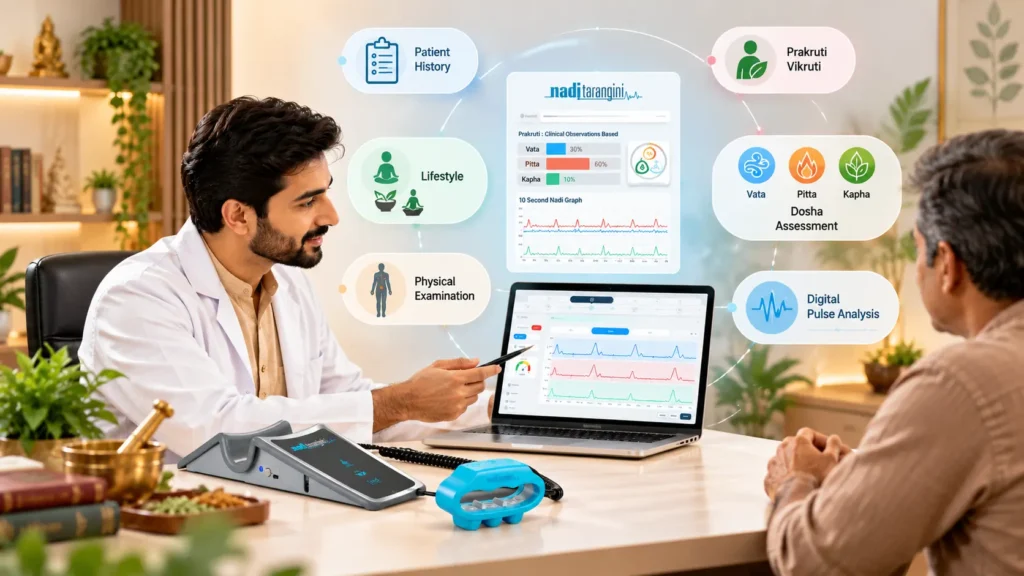
Nadi Tarangini can be positioned as a tool that supports the documentation and review of pulse-related information within this wider process.
Technology adds value when it complements clinical understanding rather than attempting to replace it.
Personalized Healthcare – The Future of Individualized Ayurvedic Treatment
Personalized healthcare is becoming an increasingly important focus in modern medicine.Patients may present with similar symptoms but differ in their constitution, lifestyle, health history, and clinical requirements.
Ayurveda’s emphasis on individual assessment provides a framework for considering these differences during consultation and treatment planning.
Nadi Tarangini can help practitioners maintain structured patient records and review information across consultations.
Nadi Tarangini can support the organization of pulse-related assessment information, which practitioners may review alongside other clinical findings.
Digital information is most useful when it contributes to a broader, practitioner-led understanding of the patient.
Longitudinal Patient Tracking – Understanding Health Over Time
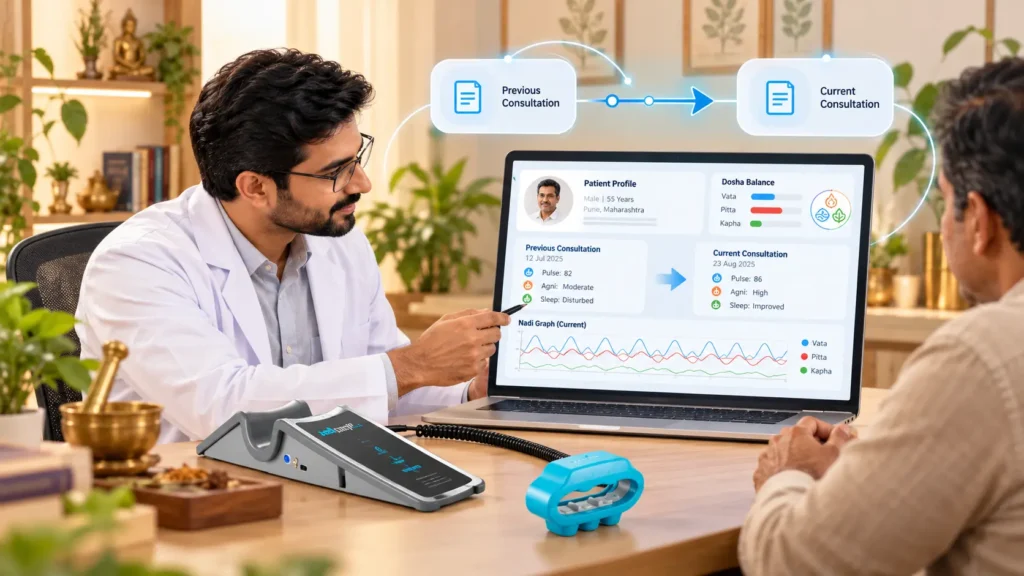
A patient’s health is not static. Symptoms, lifestyle, treatment responses, and clinical observations may change across weeks, months, or years.
For Ayurvedic practitioners, follow-up consultations can provide opportunities to review these changes and reassess the patient’s needs. Yet, without organized documentation, comparing previous and current information can become challenging.
Digital patient records can help practitioners review previous consultations, providing useful context during follow-up visits and making it easier to compare structured observations from different assessment dates. They also support documentation of treatment progress by allowing practitioners to record changes in symptoms, lifestyle, and other relevant findings over time.
Organized records can improve continuity of care, particularly when patients consult multiple practitioners, by supporting clearer communication and access to relevant clinical information. A history of documented observations can also contribute to more informed follow-up discussions and ongoing clinical evaluation.
Nadi Tarangini’s digital assessment and documentation capabilities can support this process, depending on the specific system features and clinical workflow.
In a traditional paper-based setup, practitioners may need to manage physical case papers, handwritten notes, previous prescriptions, and follow-up records.
As a clinic grows, maintaining consistent documentation can become increasingly demanding. Digital documentation offers a way to organize information and improve accessibility.
Nadi Tarangini can contribute to this digital workflow through pulse assessment records and structured reporting.
AI-Assisted Interpretation and the Importance of Clinical Validation
One of the most discussed developments in digital healthcare is AI-assisted interpretation.
AI systems can process large quantities of data and identify patterns using programmed algorithms. In pulse analytics, this may involve the processing of recorded signals and the generation of analytical outputs.
Nadi Tarangini is an advanced AI-powered pulse diagnostic device designed to speed up traditional Ayurvedic practices. It combines ultra-sensitive sensors with cutting-edge algorithms. Nadi Tarangini delivers precise pulse readings to provide detailed health insights.
This patented device helps practitioners analyze 22 Ayurvedic parameters, including Tridosha balance (Vata, Pitta, Kapha), stress levels, digestive health, and overall well-being.
Nadi Tarangini and the Future of Young Ayurvedic Practitioners
The modern Ayurvedic practitioner works in an increasingly competitive and technology-enabled healthcare environment.
Patients often expect efficient services, professional documentation, personalized attention, and continuity of care.
For young Vaidyas establishing their practices, building an organized clinical workflow from the beginning can be valuable.
Nadi Tarangini can be integrated into relevant parts of this workflow to support digital pulse assessment and record management.
Digital Ayurveda and Opportunity for Research
The future of Ayurvedic diagnostics is also closely connected to research.
Ayurveda contains a broad range of classical concepts and assessment methods. Studying these concepts through modern research methodologies requires systematic documentation and clearly defined approaches.
Digital technologies included by Nadi Tarangini can help institutions and practitioners organize clinical information and explore research questions.
Nadi Tarangini may provide a technological resource for selected research and educational applications, depending on the specific study design and available validation.
The Future – From Individual Clinics to Connected Healthcare Ecosystems
As Ayurvedic healthcare develops, technology may support greater connectivity between clinics, practitioners, wellness centres, and research institutions.
Potential applications of Nadi Tarangini includes:
- Multi-doctor clinical collaboration
- Structured patient records
- Preventive healthcare programs
- Institutional research
- Standardized documentation workflows
Nadi Tarangini can be positioned within this broader ecosystem as a digital pulse assessment and reporting tool.
The opportunity is to develop healthcare environments where information can be organized and shared appropriately while maintaining professional responsibility and patient privacy.
Nadi Tarangini – Innovation That Supports the Vaidya
The future of Ayurvedic diagnostics should not be defined by the technology used alone. It should be defined by how effectively that technology supports better clinical practice.
Understanding the patient requires more than a digital report. It requires clinical knowledge, careful observation, appropriate questioning, and the ability to connect individual findings with Ayurvedic principles.
Technology can provide information. The Vaidya provides clinical understanding. This distinction is central to responsible innovation in Ayurveda.
Nadi Tarangini brings together sensor-based pulse recording, digital analytics, and structured reporting to support practitioners in their assessment and documentation workflows.
Its potential contribution lies in helping practitioners organize pulse-related information, review recorded observations, and incorporate digital tools into personalized clinical care. However, the practitioner’s role remains fundamental.
The future of Ayurveda will depend not only on technological innovation but also on how thoughtfully these tools are integrated into clinical practice.
Nadi Tarangini shapes the future of Ayurveda by transforming traditional pulse diagnosis (Nadi Pariksha) into a standardized, AI-powered digital assessment which will benefit many domains of health care.
Conclusion: The Future of Ayurvedic Diagnostics with AI and Digital Pulse Analytics
The future of Ayurvedic diagnostics lies in combining traditional Ayurvedic knowledge with modern technology to support more structured, personalized, and well-documented healthcare. With the growing role of artificial intelligence in Ayurveda, digital Nadi Pariksha, and pulse analytics, practitioners can explore new ways to organize clinical information, document pulse assessments, and support patient consultations.
Nadi Tarangini brings these capabilities together through sensor-based pulse recording, AI-powered pulse analysis, and structured digital reports. By providing insights into 22 Ayurvedic parameters, including Vata, Pitta, and Kapha, it supports practitioners in reviewing pulse-related information alongside Prakruti, Vikruti, patient history, lifestyle factors, and other clinical findings. Digital patient records and longitudinal tracking can further support continuity of care and informed follow-up consultations.
As AI-powered Ayurvedic diagnostics continue to evolve, technology can help modernize clinical workflows while preserving the principles of traditional Ayurveda. Nadi Tarangini aims to bridge this gap by supporting Ayurvedic practitioners with digital pulse assessment and reporting tools that complement their clinical expertise. Ultimately, the future of digital Ayurveda and personalized healthcare depends on integrating technological innovation with the knowledge, experience, and clinical judgment of the Vaidya.