
Know about Hydration score from Nadi Tarangini report card
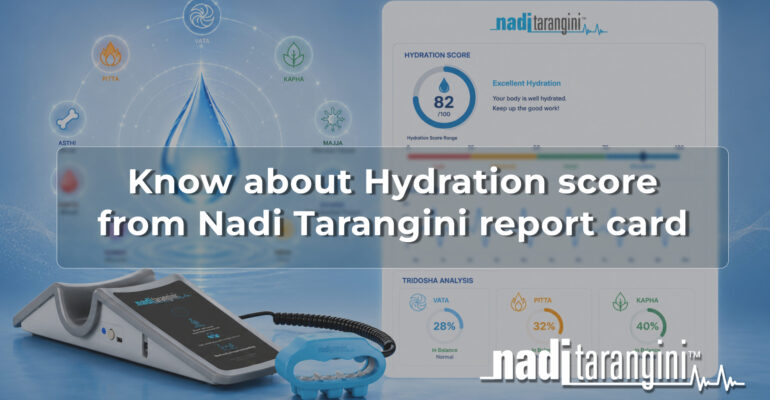
Know about Hydration score from Nadi Tarangini report card
 Vaidya Tejaswini Bhale
What is Hydration score/quotient?
Hydration is the state of maintaining an adequate amount of water and electrolytes within the body’s cells, tissues, blood, and extracellular spaces to support normal physiological functions. In modern medical science, nearly 55–70% of the adult human body consists of water, distributed as intracellular fluid (within cells) and extracellular fluid (blood plasma and interstitial fluid).
In Ayurveda,
आपः सर्वदेहधारिण्यः। चरक संहिता, सूत्रस्थान (अन्नपानविधि)
The whole body is formed and consists of water elements. This hydration is considered as liquidity and unctuous attribute dosha, kapha and pitta, fluidity and water element predominance in rasa, rakta, mansa, meda, majja and shukra dhatu. Also, mala – purish/feces, mutra/ urine and sweda/ sweat is to be considered as hydrating elements in the body.
Hydration is not merely the intake of water but also depends upon proper absorption, distribution, utilization, and elimination of fluids. Electrolytes such as sodium, potassium, chloride, magnesium, and bicarbonate play a vital role in maintaining fluid balance.
Although the classical Ayurvedic texts do not specifically use the term “hydration,” the concept is beautifully explained through Jala Mahabhuta, Udaka, Kleda, and various Srotas. Proper hydration represents the balance of fluidity, nourishment, lubrication, and cooling within the body.
Srotas , organ systems – rasa vaha, udak vaha, rakta vaha, mutra vaha and sweda vaha directly show impact on hydration levels.
उदकवहस्रोतसां तालु क्लोम च मूलम्। चरक संहिता, विमानस्थान ५
रसवहस्रोतसां हृदयं दश च धमनीः मूलम्। चरक संहिता, विमानस्थान ५
Correlation with Doshas
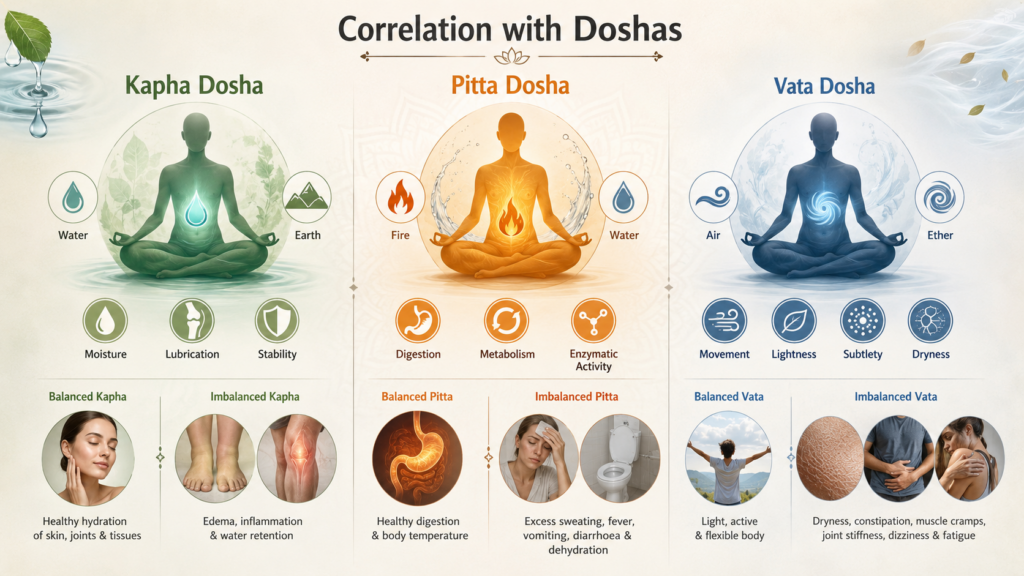
Kapha Dosha
Kapha is predominantly composed of Jala (water) and Prithvi (earth) Mahabhutas. It is mainly responsible for maintaining moisture, lubrication, stability, nourishment, and tissue cohesion. Relevant Gunas Snigdha (unctuous), Sheeta (cool) and Picchila (slimy) are related to hydration.
गुरुशीतमृदुस्निग्धमधुरस्थिरपिच्छिलाः। Charak Smahita, Sutra sthan 1
श्लेष्मा स्थिरत्वस्निग्धत्वसन्धिबन्धक्षमादिकृत्। Astang Hridaya, 11
Balanced Kapha ensures healthy hydration of skin, joints, mucous membranes, and tissues. Depletion of Kapha results in dryness, whereas excess Kapha leads to edema, inflammation and water retention.
Pitta Dosha
Pitta contains a significant liquid component and governs digestion, metabolism, and enzymatic activities. Proper hydration maintains digestive secretions and body temperature.
Pitta Gunas Drava (liquid), Sara (flowing) are related to hydration and formation of dhatus like rasa, rakta.
Loss of body fluids through excessive sweating, fever, vomiting, or diarrhoea aggravates Pitta and produces dehydration.
Vata Dosha
Vata is naturally dry (Ruksha). When body fluids decrease, Vata becomes aggravated, leading to dryness of the skin, constipation, muscle cramps, joint stiffness, dizziness, and fatigue.
Vata Gunas Ruksha (dry), Laghu (light), Chala (mobile), and Sukshma (subtle) commonly considered a manifestation of aggravated Vata with depletion of Kapha leading to dehydration.
Correlation with Dhatus
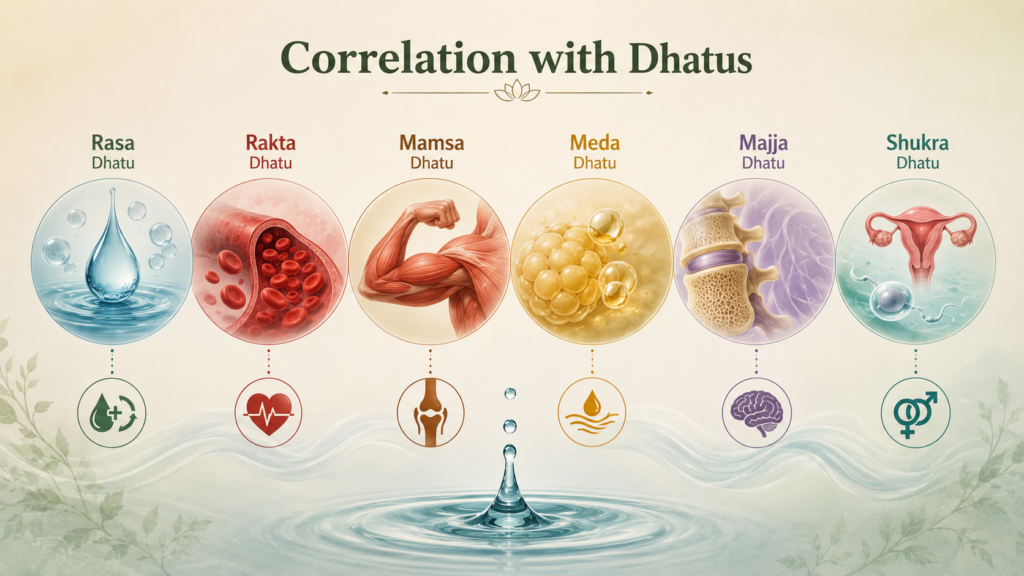
Rasa Dhatu
Rasa is the primary nourishing fluid formed immediately after digestion. It resembles plasma and lymph in modern science and is the most important Dhatu responsible for hydration. Skin, tissue nourishment, menstrual cycle, ovulation, breast milk, and overall strength, stamina and endurance to consider.
प्रीणनं जीवनं लेपः स्नेहो धारणपूरणे।
गर्भोत्पादनमित्येताः रसकर्माणि निर्दिशेत्॥ Charak Chikitsa 15
Rakta Dhatu
Adequate hydration maintains blood volume, blood circulation, and oxygen transport. Dehydration causes haemoconcentration and reduced tissue perfusion. Cardiovascular system, organs related to it liver, heart, spleen, bile duct and blood vessels to consider if any imbalance happens.
Mamsa Dhatu
Well-hydrated muscles remain flexible and strong. Dehydration results in cramps, weakness, and muscle fatigue. Musculoskeletal system, joint stiffness, arthritis, gout etc can be possible if manas dhatu hydration is low.
Meda Dhatu
Meda provides lubrication and stores water. Disturbance in Meda metabolism can contribute to edema or poor fluid distribution.
Majja Dhatu
Water is essential for healthy cartilage, intervertebral discs, bone marrow, and synovial fluid. Chronic dehydration may contribute to joint stiffness and degeneration. Also,if aggravated brain issues. Meningitis, brain tumor, SOL, slip disc, spinal cord inflammations may occur.
Shukra Dhatu
Proper hydration supports reproductive tissues and vitality. Chronic dehydration may reduce reproductive efficiency and overall strength. Excess hydration may lead to poor semen health, fragile and immbole sperms, premature ejaculation in male and uterine fibroids, ovarian cysts , endometrial and menstrual issues in women.
Correlation with Mala
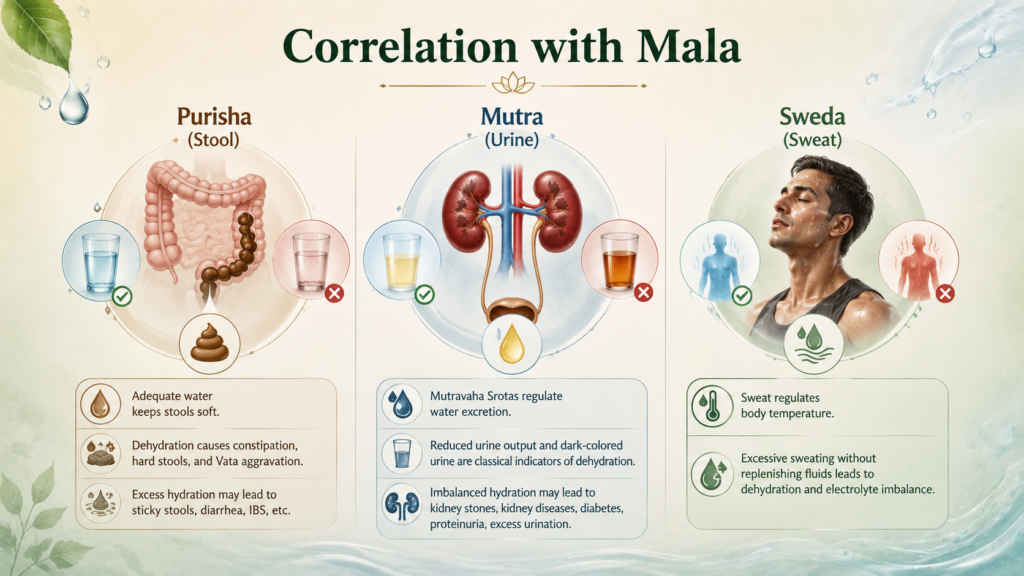
Hydration directly influences the formation and elimination of Malas.
Purisha (Stool)
Adequate water keeps stools soft. Dehydration causes constipation, hard stools, and Vata aggravation. Excess hydration may lead to sticky stools, diarrhea, IBS, etc
Mutra (Urine)
Mutravaha Srotas regulate water excretion. Reduced urine output and dark-colored urine are classical indicators of dehydration. Imbalanced hydration may lead to kidney stones, kidney diseases, diabetes, proteinuria, excess urination.
Sweda (Sweat)
Sweat regulates body temperature. Excessive sweating without replenishing fluids leads to dehydration and electrolyte imbalance.
Lets understand how hydration score is given in Nadi Taranagini report
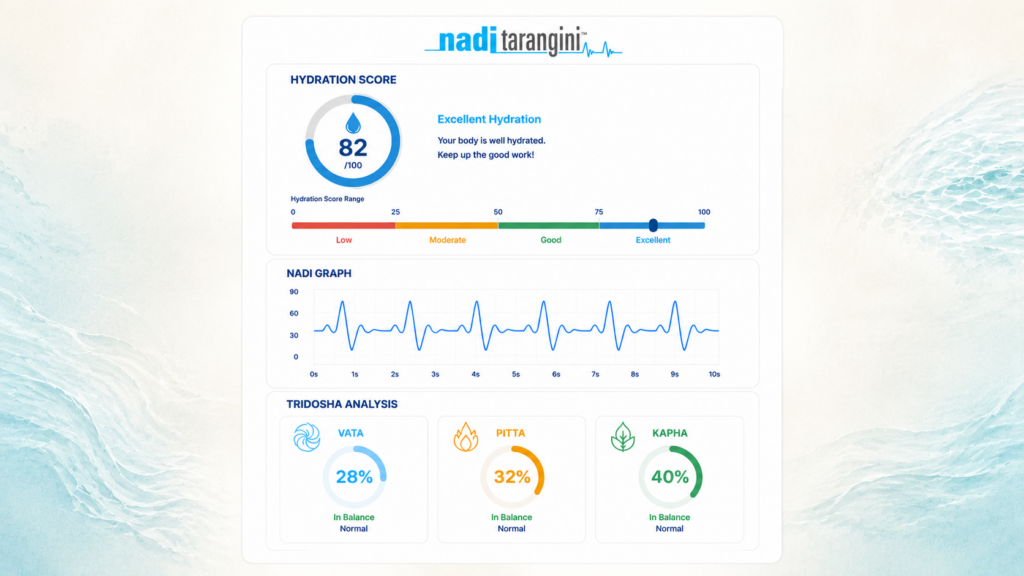
Considering all above fundamentals which we analyse through nadi pariksha including tridosha, their attributes, respective srotas and dhatu hydration score is calculated.
It is given on 0-100 scale. 10-30 is low hydration, 40-70 is moderate and above 80 to 100 is strong hydration.
According to levels the symptoms will be present in a person, of less hydration, balanced and aggravated hydration respectively.
Thus, although the term “hydration” does not appear in the classical texts, the integrated concepts of Udaka, Rasa, Kleda, Kapha, Trishna, and Srotas collectively describe the physiological state recognized in modern medicine as optimal hydration.
Proper hydration maintains Rasa, enabling nourishment of all Dhatus and ultimately supporting Ojas. Chronic dehydration can impair Dhatu nutrition, indirectly weakening immunity and vitality.