
What Can Nadi Pariksha Reveal About Prakriti and Vikriti?

What Can Nadi Pariksha Reveal About Prakriti and Vikriti?
 Dr. Gayatri Mulye
In Ayurveda, health is not merely the absence of disease; it is a harmonious state of balance between body, mind, and spirit. Ayurveda emphasizes that every individual has a unique constitution and that health depends on maintaining a dynamic balance within the body.
Two foundational concepts lie at the heart of this evaluation: Prakriti and Vikriti in Ayurveda. Prakriti represents an individual’s innate constitution, while Vikriti reflects their current state of imbalance. Understanding both is essential for an individualized approach to Ayurvedic diagnosis and patient care.
Among the various diagnostic tools in Ayurveda (Ashtavidha Pariksha), Nadi Pariksha (Ayurvedic Pulse Diagnosis) serves as a profound window into both. Through Prakriti assessment and Vikriti assessment, practitioners can evaluate constitutional characteristics and consider possible Dosha imbalances as part of a comprehensive clinical evaluation.
With the development of digital tools such as Nadi Tarangini, traditional pulse observations can also be captured, visualized, and documented through Digital Nadi Pariksha in a structured format. This creates opportunities to review observations more systematically while preserving the practitioner’s central role in interpretation and clinical decision-making.
What Is Prakriti in Ayurveda?
Prakriti refers to an individual’s inherent constitution, established at conception and traditionally understood through the relative predominance of dosha i. e. Vata, Pitta, and Kapha.
These three Doshas represent fundamental functional principles in Ayurveda. Their relative balance contributes to individual differences in physical characteristics, physiological tendencies, temperament, and responses to environmental and lifestyle factors.
Based on Dosha predominance, Prakriti is commonly classified into seven types:
- Vata Prakriti: Predominance of Vata characteristics.
- Pitta Prakriti: Predominance of Pitta characteristics.
- Kapha Prakriti: Predominance of Kapha characteristics.
- Vata-Pitta Prakriti: Combined predominance of Vata and Pitta.
- Pitta-Kapha Prakriti: Combined predominance of Pitta and Kapha.
- Vata-Kapha Prakriti: Combined predominance of Vata and Kapha.
- Sama Prakriti: A relatively balanced constitution involving all three Doshas.
Prakriti helps an Ayurvedic practitioner understand why two individuals may respond differently to similar foods, exercise routines, seasonal changes, or daily habits.
For example, two people may experience the same demanding work schedule but have different patterns of fatigue, appetite, sleep, and recovery. Understanding their constitutional characteristics can help the practitioner individualize dietary, lifestyle, and wellness recommendations.
Prakriti is relatively stable throughout life. It provides a constitutional framework rather than a diagnosis of the person’s current health status.

What Is Vikriti in Ayurveda?
While Prakriti describes an individual’s inherent constitution, Vikriti refers to the person’s current state in relation to their constitutional balance.
Ayurveda considers many factors such as dietary habits, irregular routines, inadequate sleep, emotional stress, seasonal changes, and other influences may contribute to Dosha imbalance.
Vikriti is dynamic. It may change over time depending on an individual’s circumstances, health status, habits, environment, and response to treatment.
Understanding Vikriti allows the practitioner to assess what may currently be out of balance and determine appropriate next steps.
How Can Nadi Pariksha Contribute to Understanding Prakriti and Vikriti?
Prakriti vs. Vikriti: Understanding the Difference
Prakriti helps the practitioner understand the individual’s baseline characteristics, while Vikriti helps assess the person’s present condition.
Both are important because the same finding may have different significance depending on the individual’s constitution and clinical context.
Nadi Pariksha is an important traditional assessment method in Ayurveda. Practitioners assess pulse characteristics and interpret their findings alongside the individual’s history, symptoms, examination, and other relevant information.
Within the Ayurvedic framework, pulse assessment may contribute to understanding Dosha-related patterns. However, interpreting Prakriti and Vikriti through Nadi Pariksha requires experience, contextual assessment, and professional judgment.
Nadi Pariksha is an art and science where a practitioner places three fingers: index, middle, and ring on the radial pulse at the wrist. By applying varying degrees of pressure, the practitioner assesses different layers of the pulse.
A distinct Vata pulse at this level feels like the swift, irregular movement of a serpent (Sarpa Gati).
A Pitta pulse manifests with a sharp, jumping rhythm like a frog (Manduka Gati).
A Kapha pulse feels broad, deep, and smooth, resembling the graceful movement of a swan (Hansa Gati).

Role of Nadi Tarangini in Assessment of Pakriti – Vikriti
To appreciate the diagnostic power of Nadi Pariksha, it is essential to first distinguish between Prakriti and Vikriti:
An effective Ayurvedic therapeutic plan aims to calm the aggravated Doshas (reducing Vikriti) to restore the individual back to their original baseline (Prakriti).
Nadi Pariksha can contribute to understanding these dimensions as part of a comprehensive Ayurvedic consultation. Digital pulse assessment systems, including Nadi Tarangini, can further support the process by capturing pulse signals, presenting visual representations, and organizing observations for documentation and follow-up.
Nadi Tarangini assesses an individual’s Prakriti by combining a digital questionnaire for baseline traits with patented pressure-sensor wrist technology that measures real-time pulse waveforms at the Vata, Pitta, and Kapha arterial sites. AI algorithms decode these mechanical signals to map dominant constitutional energies.
Assessment Process
• Digital Questionnaire: The practitioner or user first completes a baseline intake form covering physical and psychological traits to record inherent Prakriti.
• Sensor Placement: The doctor’s unit places three pressure sensors directly over the radial artery at specific positions corresponding to Vata, Pitta, and Kapha.
• Pulse Wave Capture: The device converts mechanical pulse pressure into digital time-series data, tracking four sub-wave components (percussion, tidal, valley, dicrotic or PTVD pattern) for roughly two minutes.
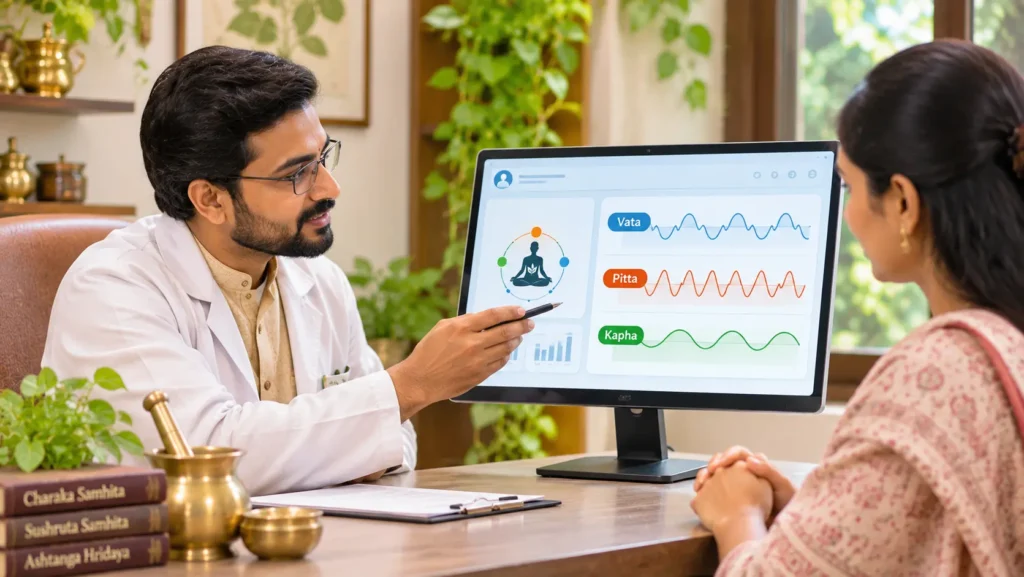
• Color-Coded Analysis: Software displays distinct waveforms typically blue for Vata, red for Pitta, and green for Kapha to evaluate relative strength, rhythm, and tension (Nadi Gati, Bala, and Akruti).
Key Parameters Evaluated
• Tridosha Balance: Compares the amplitudes and stability of the three wave signatures to distinguish permanent Prakriti from current Vikriti (imbalance).
• 22 Ayurvedic Metrics: Analyzes physiological indicators like digestive fire (Agni), tissue vitality, stress levels, and pulse characteristics.
• Personalized Output: Generates reports via the Nadi Tarangini Platform offering tailored diet, lifestyle, and yoga adjustments.
Nadi Tarangini: Bridging Classical Prakriti Assessment and Digital Pulse Analytics
A meaningful Ayurvedic consultation considers both the person’s inherent constitution and their present condition.
Focusing only on Prakriti may overlook current changes that require attention. Focusing only on Vikriti may overlook the constitutional differences that help explain why individuals respond differently to similar circumstances.
Integrating both perspectives supports a more comprehensive approach to individualized assessment in following ways
1. Exploring Constitutional Tendencies
During a consultation, pulse assessment may contribute to the practitioner’s broader understanding of an individual’s constitutional characteristics.
These observations can be considered alongside other Prakriti assessment methods, including physical characteristics, appetite, sleep patterns, habitual responses, and personal history.
2. Assessing the Current State
Pulse characteristics may also be examined as part of an assessment of the person’s current condition.
The practitioner considers the patient’s presenting symptoms, recent lifestyle changes, digestive patterns, sleep, emotional state, and other clinical findings. In traditional Ayurvedic interpretation, these observations may help inform the assessment of possible Dosha aggravation or imbalance.
Importantly, a pulse finding should not be interpreted in isolation. It is one component of a broader clinical evaluation.
3. Supporting Individualized Chikitsa
Understanding both Prakriti and Vikriti can help practitioners develop a more individualized approach to Chikitsa.
Prakriti provides insight into the person’s constitutional tendencies, while Vikriti helps the practitioner focus on current concerns and possible contributing factors.
For example, two patients reporting digestive discomfort may have different constitutional assessments, symptom patterns, dietary habits, and associated findings. Their management plans may therefore differ.
Why Structured Digital Pulse Reports Are Changing the Game
While Nadi Pariksha is a deeply intuitive skill, communicating these subtle pulse subtle readings to patients or tracking them across multiple visits has historically been a challenge. Modern Ayurvedic practices are bridging this gap through structured digital pulse reports.
Here is how digital reporting elevates Ayurvedic consultation and patient care:
Clear Visual Differentiation
Digital reports by Nadi Tarangini present clear, graphical representations comparing Prakriti and Vikriti side-by-side. Seeing visual dosha charts helps patients instantly grasp concepts like “My natural state is Pitta-Kapha, but my current high Vata is causing my anxiety and digestion issues.”
Objective Tracking Over Time
By digitizing and standardizing parameters (such as pulse rate, depth, rhythm, and doshic dominance), practitioners can generate progress reports across consecutive visits. Patients can visually track how treatments, dietary changes, and herbs actively lower their Vikriti back toward baseline.
Enhanced Practitioner Communication
Structured digital reports allow practitioners to document findings with precision, creating standardized records that can easily be shared across clinical teams, integrative health settings, or for research and case documentation.
Longitudinal comparison
When comparable observations are recorded over multiple visits, practitioners can review them alongside changes in symptoms, lifestyle, and treatment plans.
Nadi Tarangini can support this approach through digital pulse capture, visual representations, and analytical features designed to assist the practitioner. Such tools can be particularly useful when practitioners want to maintain organized patient records and review observations across consultations.
This provides a more organized basis for clinical discussion and follow-up.
For young Vaidyas, established practitioners, and clinics adopting digital workflows, structured documentation can help bring greater consistency to consultation records. Over time, carefully maintained records may also support clinical review and research, provided that observations are recorded using appropriate methods and interpreted with suitable scientific rigor.
Conclusion:
Nadi Pariksha remains one of the most elegant and complete diagnostic methods in natural medicine. By evaluating the subtle nuances of both the deep and superficial pulse, it grants practitioners insights into an individual’s inherent constitution (Prakriti) and current state of imbalance (Vikriti). Through Prakriti and Vikriti assessment, practitioners can better understand constitutional tendencies and evaluate possible Dosha imbalances as part of a comprehensive Ayurvedic consultation.
The future of Ayurvedic diagnosis lies in combining classical Ayurvedic principles, careful clinical judgment, and responsible digital innovation. With Digital Nadi Pariksha and structured digital pulse assessment, technologies such as Nadi Tarangini can support practitioners in capturing pulse observations, visualizing findings, and maintaining organized clinical records.
As traditional Ayurvedic Pulse Diagnosis integrates with structured digital reporting tools, practitioners can communicate their observations more clearly, support individualized consultations, and maintain continuity in patient care while preserving the fundamental principles of Ayurveda.