
The Foundation of Digestive Health and Preventive Wellness in Ayurveda : Jatharagni Root of Health as per Science of wisdom
The Foundation of Digestive Health and Preventive Wellness in Ayurveda : Jatharagni Root of Health as per Science of wisdom
 Vaidya Tejaswini Bhale
Jatharagni or Agni or digestive fire is the most crucial and fundamental concept in Ayurveda. When the word Agni comes, it itself indicates the presence of fire element or Tejas Mahabhuta. Agni has qualities like Ushna (hot), Tikshna (sharp), Snigdha (Unctuous), Sukshma (subtle), Sara (flowing) and Drava (liquid nature). Among the three Doshas, Pitta Dosha carries similar qualities of Tejas Mahabhuta. Because of these qualities, Pitta mainly governs the functioning of Jatharagni and supports digestion, transformation and metabolism inside the body.
Agni is responsible for proper digestion of Ahara (food), transformation of nutrients, metabolism at tissue level and also helps in proper excretion of waste products. When food is digested by balanced Agni, it forms a healthy base for both Sharira (body) and Mana (mind). Balanced Agni gives stability and clarity to mind and promotes Satva Guna which is responsible for positive thinking, concentration, emotional balance and mental strength.
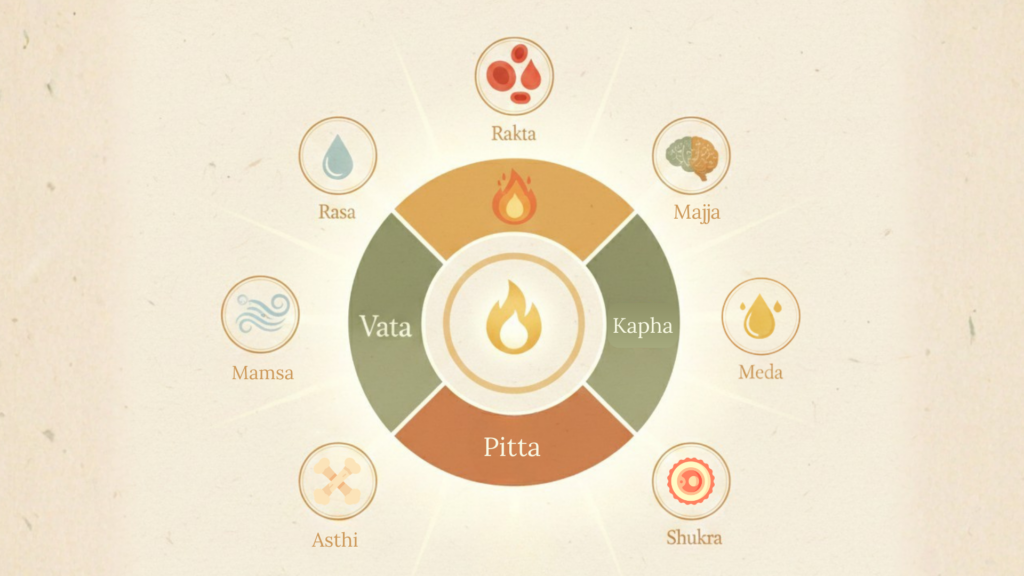
In Ayurveda, health is defined as *Samadosha, Samagni, Samadhatu and Mala Kriya with Prasanna Atma, Indriya and Mana*. Among these, Agni plays a central role. When Agni is balanced, it helps in maintaining proper balance of three Doshas – Vata, Pitta and Kapha. It also supports the nourishment and proper formation of Sapta Dhatus which are Rasa (Plasma), Rakta(blood), Mamsa (muscle), Meda (fat), Asthi (bones), Majja( bone marrow, brain) and Shukra (ovum, sperm). From the well nourished Dhatus, “Ojas” is formed which is considered the essence of immunity, vitality and strength of the body.
Balanced Agni also maintains proper functioning of Malas that are Purisha (feces), Mutra (urine) and Sweda (sweat). When Agni is in a balanced state, bowel movement remains regular, stool is well formed, soft and smooth without strain. Urine remains clear, pale yellow in colour with normal frequency around 6 to 7 times in a day depending upon water intake and body constitution. Sweda or sweating happens properly during physical activity and helps in elimination of toxins through skin which indicates a good detoxification process of the body.
Agni is not only limited to Jatharagni. Ayurveda also explains Bhutagni and Dhatvagni. Bhutagni helps in transformation of Panchamahabhuta elements present in food and Dhatvagni helps in metabolic conversion at each tissue level for nourishment of next Dhatu in sequence. If Jatharagni is balanced, Bhutagni and Dhatvagni function properly, resulting in strong tissue metabolism and healthy Dhatu formation.
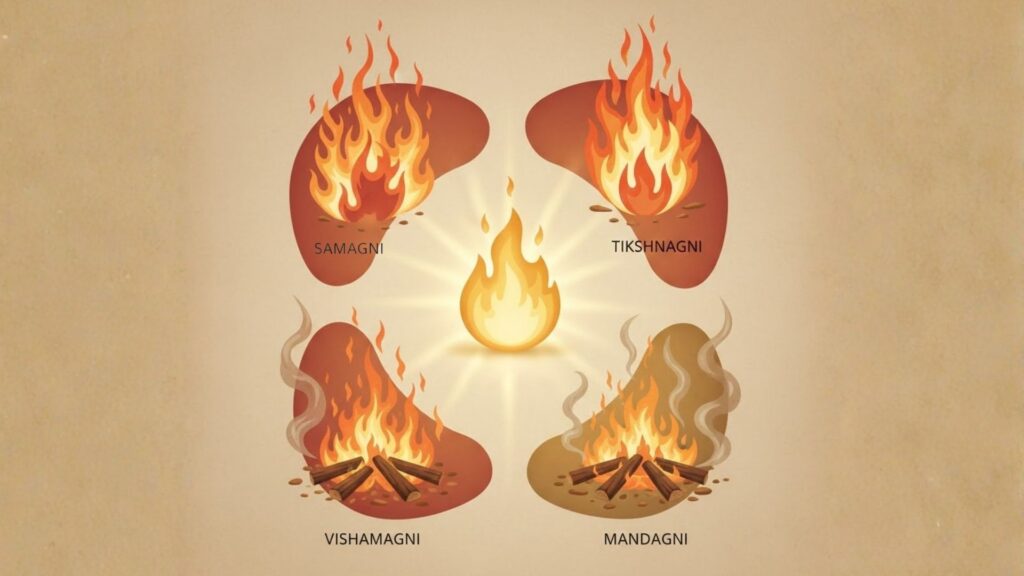
Agni can exist in four main conditions.
- When digestion is proper and appetite is stable, it is called Samagni which is the healthy and balanced state.
- When digestive capacity becomes excessive, producing strong hunger, acidity or burning sensation, it is called Tikshnagni.
- When digestive strength becomes weak, producing heaviness, loss of appetite, Ama formation and sluggish metabolism, it is called Mandagni.
- When digestion becomes irregular with fluctuating appetite, bloating, gas and unpredictable digestion, it is called Vishamagni which is mainly related with Vata imbalance.
In Nadi Tarangini or Nadi Pariksha based analysis, Agni condition can be understood through numerical representation.
- If the Agni level is below 40, it indicates Mandagni.
- If it ranges between 50 to 70, it represents Samagni which is ideal.
- If the level goes above 80, it indicates Tikshnagni.
- When Agni readings fluctuate during repeated assessments over different days, it indicates Vishamagni.
Agni also changes according to Ritu (season), Prakriti (constitution) and Vaya (age). During Hemant and Shishir Ritu, which is the winter season, Agni naturally becomes strong or Prabala due to external cold and internal heat conservation. If during this season a person shows Mandagni, it indicates imbalance.
During Grishma Ritu or summer season, Agni naturally becomes weaker due to heat and dehydration. If during this season a person shows Tikshnagni, it indicates pathological condition.
Agni also varies according to Prakriti. Kapha Prakriti individuals generally show Mandagni with slow digestion. Pitta Prakriti individuals show Tikshnagni with sharp and fast digestion. Vata Prakriti individuals show Vishamagni with irregular appetite and digestion patterns.
Therefore, while assessing Agni, comparison must always be done with Prakriti, season, age and clinical findings through Prashna Pariksha, Darshana Pariksha, Sparshana Pariksha and Nadi Pariksha.
When the state of Agni does not match with Prakriti, season or natural physiological condition, it is called Vikriti or imbalance of Jatharagni. This imbalance may lead to metabolic disorders like thyroid imbalance, diabetes, IBS, autoimmune disorders, stress related disorders and depression because formation of Ama starts when Agni becomes weak or disturbed.
Therefore, in Ayurveda, Jatharagni is considered as the Moola or root of health. Maintenance of balanced Agni is possible through proper Ahara (diet), Vihara (lifestyle), Nidra (sleep), Vyayama (exercise), Yoga, meditation and seasonal regimen or Ritucharya. When Agni remains balanced, it maintains harmony between body, mind and soul and supports disease prevention as well as treatment.
Author: Vaidya Tejaswini Bhale (Ayurvedacharya, Nadi Pariksha Expertise)