
How Rutucharya and Jatharagni are Co-related?

How Rutucharya and Jatharagni are Co-related?
 Vaidya Tejaswini Bhale
In Ayurveda based clinical practice, Ayurveda aims at prevention of diseases. In this prevention aspect the major role is of Deenacharya and Rutucharya.
How and why this Rutucharya is described by Aacharyas is the curiosity of all people including Ayurveda professionals.
The research study done by Nadi Tarangini research team puts more light on fundamentals of Rutucharya through study of Vinshati Guna (20 qualities of Tridosha) which we can study through Nadi pariksha.
Jatharagni is regarded as the primary determinant of health, disease resistance, and longevity. Experienced physicians consistently observe that when digestive fire is balanced, the body maintains strength, clarity of mind, emotional stability, and efficient tissue nourishment. Conversely, impairment of Agni becomes the starting point for most acute and chronic disorders. This understanding, deeply rooted in classical texts, has also been validated through contemporary tools such as Nadi Pariksha and structured observational research on digestive patterns.

Ayurveda explains that every entity in the universe is formed by the Panchamahabhuta—Prithvi (earth), Aap (water), Tejas (fire), Vayu (air), and Akash (ether). The human body, being Panchabhautik, expresses these elements through the functional principles of Vata, Pitta, and Kapha. These Tridoshas govern all physiological, metabolic, and psychological processes and continuously respond to age, season, geography, diet, and lifestyle.
From a wellness perspective, Kapha provides structure and stability, Pitta governs transformation and metabolism, and Vata regulates movement and communication within the body. Health is maintained when these forces remain in equilibrium and when digestion effectively nourishes the Saptadhatu while eliminating waste through Trimala. The efficiency of this entire system depends upon the state of Jatharagni.
Seasonal and Daily Influence on Digestive Fire
Ayurveda emphasizes that Agni is not static; it fluctuates with environmental rhythms. Seasonal dominance of Dosha directly influences digestive capacity. Vata accumulates during Greeshma Rutu and aggravates in Varsha Rutu, Pitta aggravates in Sharad Rutu, while Kapha accumulates in Shishir Rutu and aggravates in Vasant Rutu.
Daily cycles (Prahar) further modulate digestion. Kapha predominates during early morning and evening hours, Pitta during midday and midnight, and Vata during late afternoon and early morning hours. These natural rhythms explain variations in appetite, digestion, mental clarity, and physical stamina observed in clinical practice.
Understanding these cycles allows practitioners to guide patients toward appropriate meal timing, food quantity, and activity levels, enhancing digestive efficiency without reliance on medication.
Functional Types of Jatharagni
Balanced digestion is termed Samagni, wherein food is digested completely and without discomfort. When imbalanced, Agni presents as Tikshnagni, Vishamagni, or Mandagni. Clinically, these imbalances manifest as Arochaka, Apachana, Chardi, Hrullasa, Atisara, Malavashambha, and loss of appetite.
Long-standing Agni imbalance also affects mental and emotional health through disturbance of Sadhak Pitta and Manas Bhava, leading to irritability, restlessness, excessive thinking, anger, or depression. From a preventive wellness standpoint, early identification of Agni status is therefore crucial.
Rutucharya and Digestive Wellness
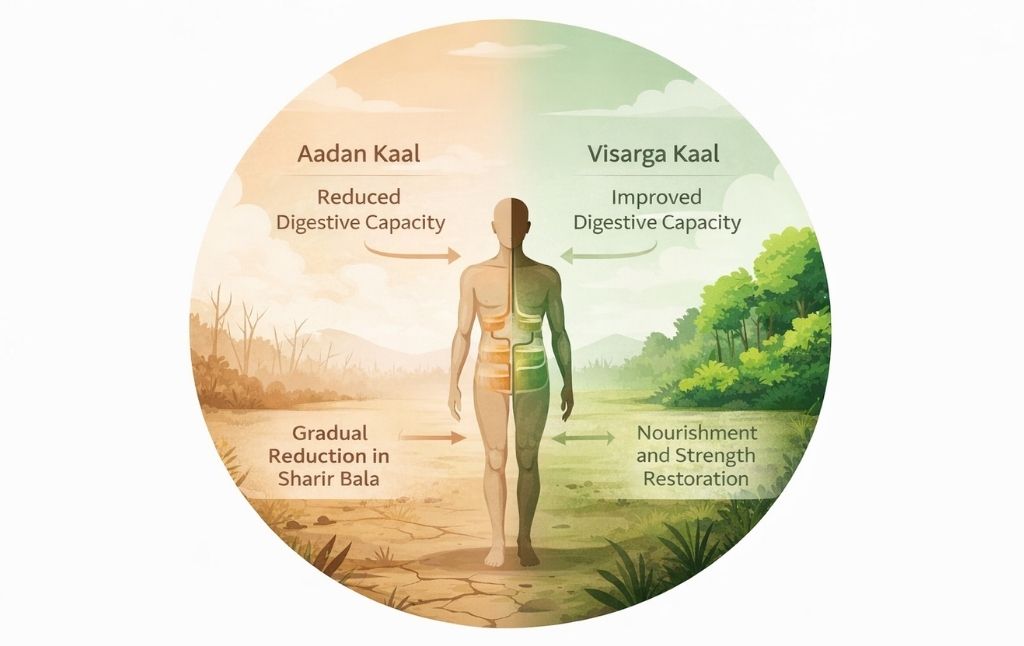
Ayurveda strongly advocates Rutucharya and Dinacharya to preserve digestive strength. The annual cycle is divided into Aadan Kaal and Visarga Kaal. During Aadan Kaal, increased solar intensity leads to dominance of Ushna, Tikshna, and Ruksha Guna, gradually reducing Sharir Bala and digestive capacity. In contrast, Visarga Kaal is nourishing and strengthening due to lunar influence, promoting better digestion and tissue replenishment.
Observational Insights from the Study
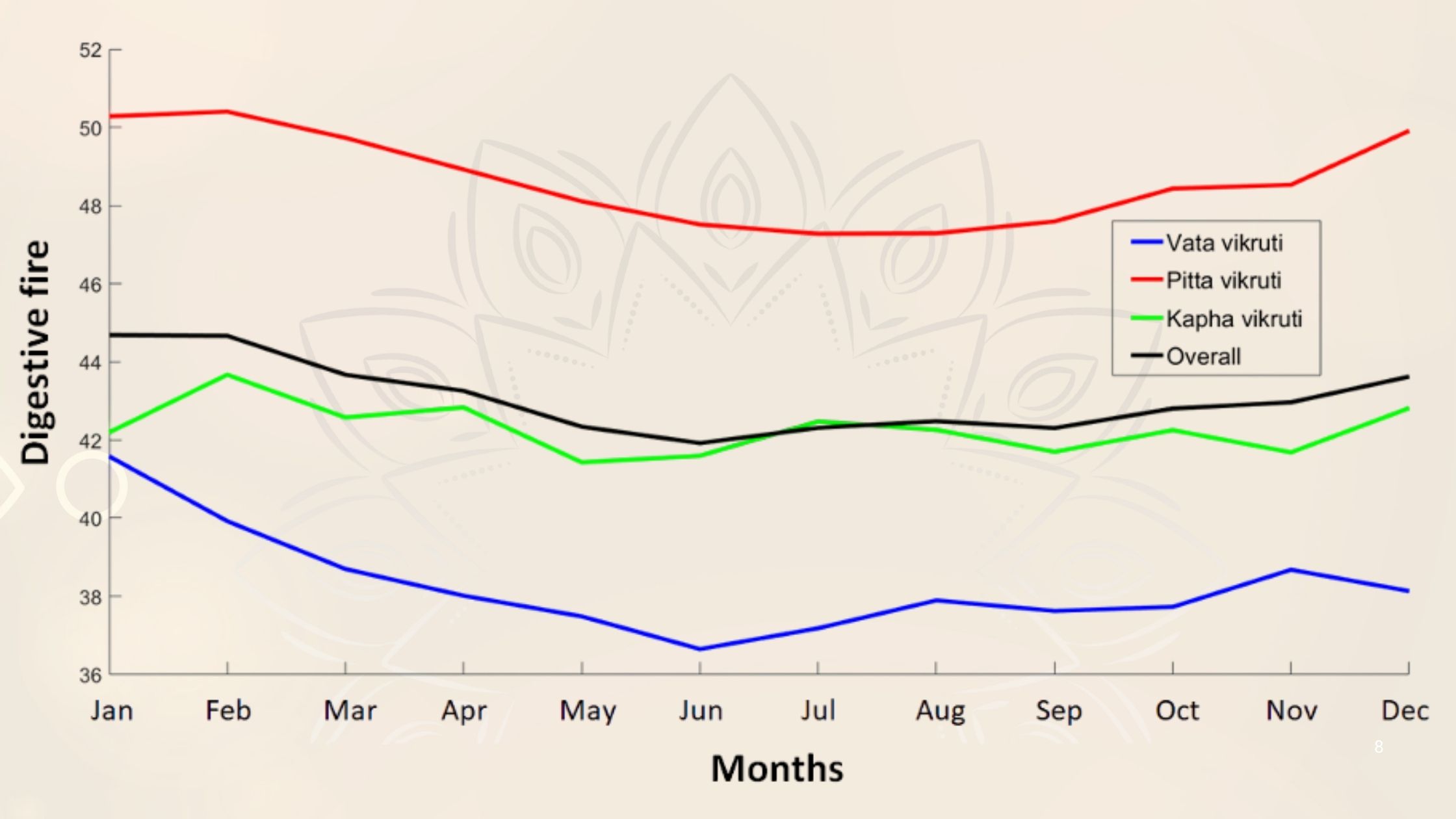
In our observational study done in the year 2018-2019 of 25,437 individuals using Nadi Tarangini, Nadi pariksha platform, digestive fire was consistently higher during winter months. Jatharagni showed a declining trend with the onset of summer and remained low throughout the monsoon. When correlated with Hindu Rutu, values were highest during Hemant and Shishir Rutu and lowest during Greeshma and Varsha Rutu. Moderate levels were observed during Vasant and Sharad Rutu.Classical texts note that Jatharagni is weakest during Greeshma and Varsha Rutu. Chaturmas, traditionally observed during the monsoon, emphasizes Laghu Aahar, acknowledging the natural state of Agnimandya during this period. This guidance remains highly relevant in modern preventive healthcare.
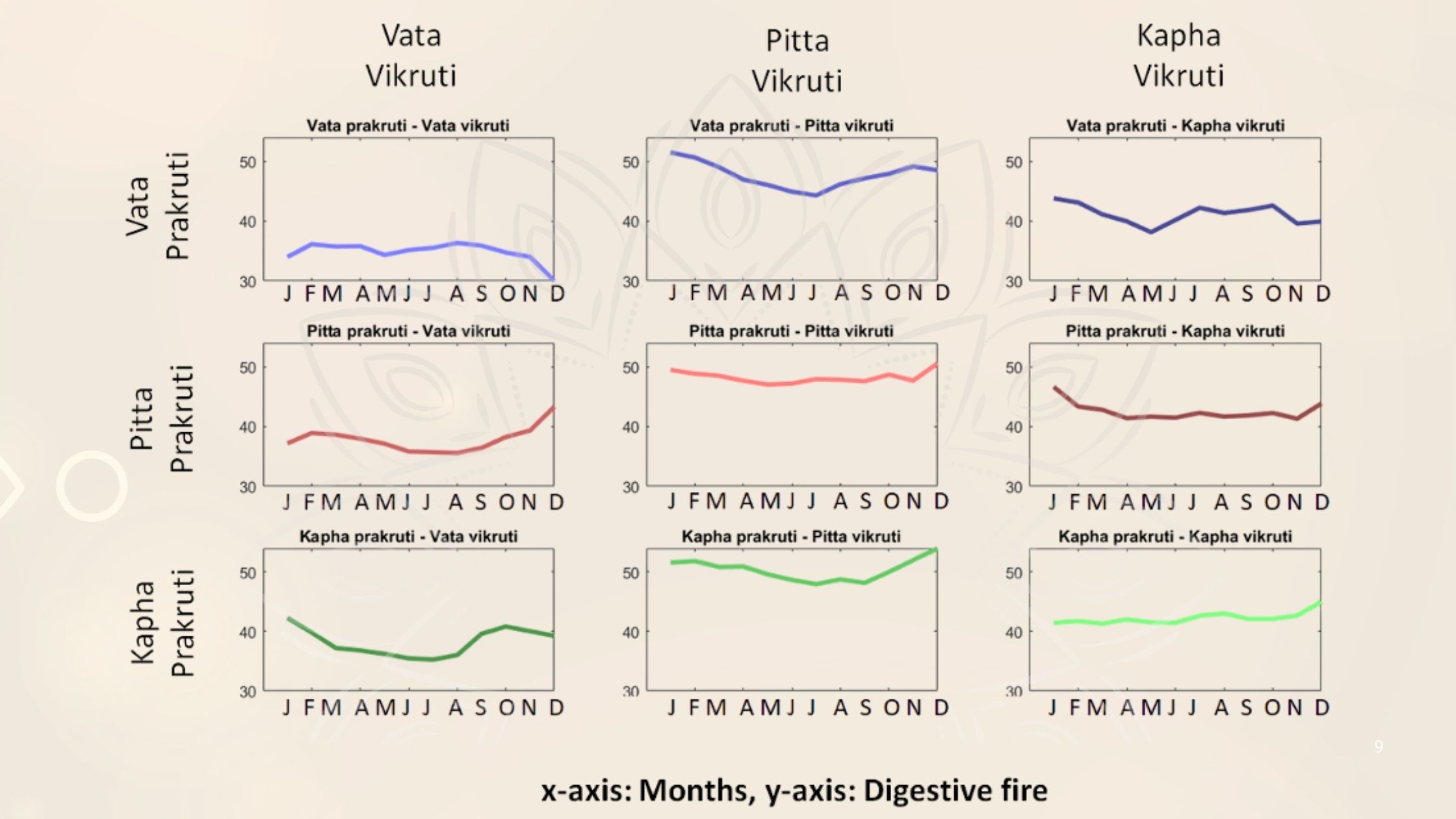
Analysis based on Prakriti and Vikriti revealed patterns identical to classical descriptions. Vata Prakriti individuals demonstrated greater fluctuations in digestive fire, reflecting Vishamagni, especially when Vata Vikriti was present. Pitta Prakriti individuals showed consistently higher values, aligning with Tikshnagni, with the highest readings in Pitta-Pitta combinations. Kapha Prakriti individuals showed lower values with minimal fluctuation, corresponding to Mandagni, particularly in Kapha-Kapha profiles.
Practical Implications for Wellness Practice
These findings reinforce the Ayurvedic principle that dietary quantity, caloric intake, and food complexity must align with seasonal digestive capacity. During Varsha Rutu, when Agni is naturally low, lighter diets support digestion and prevent toxin accumulation. During Hemant and Shishir Rutu, stronger digestion allows for heavier, nourishing foods without adverse effects.
This data-based validation bridges classical wisdom with modern wellness practice, offering practitioners a practical framework to guide diet, lifestyle, and seasonal routines based on measurable digestive trends.
Conclusion
Ayurveda is fundamentally a preventive and lifestyle-oriented system of medicine. While its principles are deeply observational, they have often lacked validation in contemporary language. This study demonstrates that classical descriptions of Jatharagni, Rutucharya, and Prakriti-based digestion are strongly supported by large-scale, year-long data.
Understanding and respecting digestive rhythms—seasonal, daily, and constitutional—can significantly enhance preventive care, reduce disease burden, and improve overall wellbeing. This approach can be further explored across age groups and geographical regions to refine personalized wellness strategies rooted in both tradition and evidence.
For full paper click below link
https://www.jahm.co.in/index.php/jahm/article/view/24
Author: Vaidya Tejaswini Bhale (Ayurvedacharya, Nadi Pariksha Expertise)